

A multiplication matrix of an element  in a finite-dimensional associative commutative algebra
 with multiplicative
identity over a field
 is the matrix, in a chosen vector
basis, of the
 -linear transformation
 |
(1)
|
Changing the vector basis replaces  by a similar matrix.
For elements
 ,
the matrices satisfy
 |
(2)
|
For polynomial equations, let  , where
 is a zero-dimensional
ideal. Choose polynomial representatives
 , ...,
 of a vector basis of this
quotient ring. The
 th column of
 is determined by
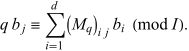 |
(3)
|
A Gröbner basis computes these expressions by polynomial division when the  are the monomials not divisible
by any of its leading monomials (Sturmfels 2002,
p. 17).
When  ,
let
 be the finite set of common zeros of
 . For
 , the evaluation vector
 satisfies
 |
(4)
|
Thus the eigenvalues of  are the values
 . More precisely, its characteristic
polynomial is
 |
(5)
|
where  is the identity matrix and
 is the dimension over
 of the localization
of
 at the maximal ideal corresponding to
 (Cox 2021). Common left eigenvectors
of
 ,
...,
 give consistent coordinate tuples. Separate lists of eigenvalues
do not in general determine which coordinates belong to the same solution. If
 , where
 is the ideal radical,
these matrices can be diagonalized in a common vector
basis (Sturmfels 2002, pp. 17-18). This gives an eigenvalue
method for solving finite systems of polynomial
equations (Auzinger and Stetter 1988, Trott 2006).
In one variable, multiplication by  on
 , for a monic
polynomial
 of polynomial degree
 , gives the standard companion
matrix in the vector basis
 ,
 , ...,
 .
