TOPICS
Search

Multiple Ergodic Average


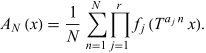
A multiple ergodic average is an average of products of functions evaluated at different iterates of a measure-preserving map T. For bounded measurable functions f_1, ..., f_r and integer slopes a_1, ..., a_r, a linear multiple ergodic average is

 A_N(x)=1/Nsum_(n=1)^Nproduct_(j=1)^rf_j(T^(a_jn)x).

Negative slopes require an invertible map whose inverse is a measurable function. For one function, Birkhoff's ergodic theorem describes the almost everywhere convergence of these averages under its integrability and ergodicity hypotheses.


See also

Birkhoff's Ergodic Theorem, Ergodic Theory, Mixing Transformation, Rokhlin's Multiple-Mixing Problem

Explore with Wolfram|Alpha

References

Eisner, T.; Farkas, B.; Haase, M.; and Nagel, R. Operator Theoretic Aspects of Ergodic Theory. Extended Version, Apr. 22, 2016. https://www.math.uni-leipzig.de/~eisner/book-EFHN.pdf.

Cite this as:

Weisstein, Eric W. "Multiple Ergodic Average." From MathWorld--A Wolfram Resource. https://mathworld.wolfram.com/MultipleErgodicAverage.html

Subject classifications