TOPICS
Search

Mixing Transformation


A mixing transformation is a measure-preserving transformation T on a probability space (X,F,mu) for which

 mu(A intersection T^(-n)B)->mu(A)mu(B)

as n->infty for every pair of measurable sets A and B. Thus observations separated by a long time become asymptotically independent. A mixing transformation is an ergodic transformation, since applying the condition to a measurable set A invariant modulo a set of measure zero gives mu(A)=mu(A)^2.

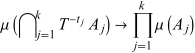
For an invertible T whose inverse is a measurable function, mixing of order k, where k>=2 is an integer, means that for every choice of measurable sets A_1,...,A_k,

 mu( intersection _(j=1)^kT^(-t_j)A_j)->product_(j=1)^kmu(A_j)

whenever the integers t_1<...<t_k satisfy min_(1<=j<k)(t_(j+1)-t_j)->infty. The order counts the number of sets. Rokhlin's multiple-mixing problem asks whether mixing of order 2 implies mixing of every finite order for one transformation.


See also

Ergodic Theory, Ergodic Transformation, Invariant Measure, Measure-Preserving Transformation, Rokhlin's Multiple-Mixing Problem

Explore with Wolfram|Alpha

References

Eisner, T.; Farkas, B.; Haase, M.; and Nagel, R. Operator Theoretic Aspects of Ergodic Theory. Cham, Switzerland: Springer, 2015. https://doi.org/10.1007/978-3-319-16898-2.Ryzhikov, V. V. "Multiple Mixing, 75 Years of Rokhlin's Problem." 12 Nov 2024. https://arxiv.org/abs/2411.07234.

Cite this as:

Weisstein, Eric W. "Mixing Transformation." From MathWorld--A Wolfram Resource. https://mathworld.wolfram.com/MixingTransformation.html

Subject classifications