

The Morris-Lecar model is a conductance-based dynamical system for electrical oscillations in an excitable membrane (Morris and Lecar
1981). In its planar form, the calcium gate is set to its instantaneous equilibrium
value. The remaining variables are the membrane voltage  and the fraction
 of open potassium channels. The ordinary
differential equations are
 |  |  |
(1)
|
 |  |  |
(2)
|
where  and
 are functions of time and primes denote derivatives
with respect to
 . The constant
 is capacitance,
 is applied current, and
 and
 are the maximal conductance and reversal potential for the
leak, calcium, and potassium terms. The gate functions are
 |  | 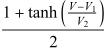 |
(3)
|
 |  | 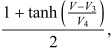 |
(4)
|
where  and
 are the half-activation voltages,
 and
 are nonzero voltage scales, and
 sets the potassium gate rate. The
 -nullcline is
 . Since
 , the interval
 is invariant for the gate.
For example, take  ,
 ,
 ,
 ,
 ,
 ,
 ,
 ,
 ,
 ,
 ,
 , and
 . Numerical integration
from the initial state
 shows approach to a periodic
orbit. The planar model allows the onset of oscillations to be studied through
intersections of its nullclines and changes in the
stability of the resulting equilibria (Morris
and Lecar 1981).
