

The modified Chebyshev algorithm constructs the three-term recurrence relation of orthogonal polynomials
from moments expressed in an auxiliary polynomial basis. For a finite positive
measure  on the real line, let the known monic
polynomials
 satisfy
 |
(1)
|
with  and
 . For a positive
integer
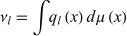
 , the input consists of the modified moments
 |
(2)
|
for  , 1, ...,
 ,
with
 . Assume the polynomial inner product is positive
definite through degree
 .
The desired monic polynomials satisfy
 |
(3)
|
with  and
 (Gautschi 1982).
Set  ,
 ,
 , and
 . The intermediate quantities
 obey
 |
(4)
|
for  , ...,
 and
 ,
...,
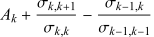
 . The recurrence coefficients
are then
 |  |  |
(5)
|
 |  |  |
(6)
|
The value  records the mass normalization and does not affect the zero term
 . Choosing
 gives
 ,
reducing the method to the original power-moment construction.
The diagonal entries  and off-diagonal entries
 ,
 ,
form the associated Jacobi matrix. The Golub-Welsch
algorithm then gives Gaussian quadrature
nodes and weights. A suitable auxiliary family can improve
conditioning, but this is not automatic. The modified moments must themselves be
computed accurately; changing basis after errors have entered the power moments does
not restore the lost information (Wheeler 1974, Gautschi 1982).
