


The minimum number of determined circles is the least number  of distinct circles through
at least three points of an
 -point set in the plane
whose points are neither all collinear nor all concyclic,
for
 (Elliott 1967). A circle through more than three of the
points is counted once. Erdős (1961) posed the question with the concyclic
case excluded. Elliott (1967) also excluded the collinear
case, which would give zero circles. This is problem 506
in the Erdős problems.
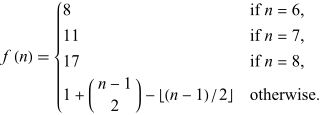
The minimum is
 |
(1)
|
Here  denotes the floor function. For
 , 5, or
 ,
a minimizing configuration consists of the center of a
circle together with
 points on it. The points on the circle
form
 antipodal pairs and, when
 is even, a single unpaired point. Each nonantipodal pair determines
a distinct circle through the center,
in addition to the original circle (Purdy and Smith 2010,
Cambie et al. 2026).
Jucovič (1967) determined the cases from 4 through 6, and Purdy and Smith (2010) proved the formula for  .
Wang (2026) gave the complete classification. Cambie et al. (2026) gave shorter
proofs for
 and
 .
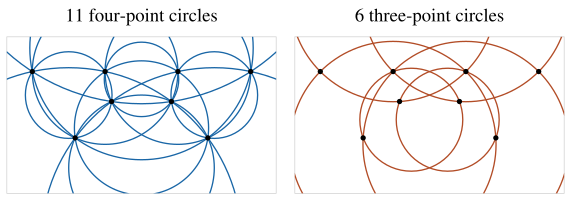
The illustrated extremal eight-point configuration has four points  for
 ,
 ,
 ,
and
 , where
 .
The other four points are
 and
 .
These eight points determine 11 circles through four points
each and six ordinary circles, each containing exactly
three of the points (Cambie et al. 2026).

 Points." Acta Math. Acad. Sci. Hungar. 18,
181-188, 1967.