

The Mermin-Wagner theorem states that a one- or two-dimensional isotropic Heisenberg spin model with finite-range exchange interaction can have neither ferromagnetic nor antiferromagnetic long-range order at any positive temperature.
An isotropic Heisenberg spin model places a fixed-size spin  at every site
  of a
of a  -dimensional point lattice.
In a classical model, the spins are vectors with the same
vector norm. In a quantum model, their components
are linear operators on a Hilbert
space. The interaction energy has the form
-dimensional point lattice.
In a classical model, the spins are vectors with the same
vector norm. In a quantum model, their components
are linear operators on a Hilbert
space. The interaction energy has the form
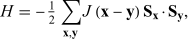 |
where  specifies the interaction strength between two sites. Finite range means that
  whenever
  for some fixed
  . The dot product makes
  invariant under simultaneous continuous
rotations of all spins. With the system size taken to
infinity before an applied symmetry-breaking
field is sent to zero, both the uniform and staggered spin expectation
values vanish (Mermin and Wagner 1966, Friedli and Velenik 2017).
invariant under simultaneous continuous
rotations of all spins. With the system size taken to
infinity before an applied symmetry-breaking
field is sent to zero, both the uniform and staggered spin expectation
values vanish (Mermin and Wagner 1966, Friedli and Velenik 2017).
After a Fourier transform, the proof gives a bound whose small-wave-vector part contains the integral
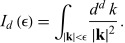 |
This integral diverges at  for
for  , excluding the assumed order. The continuous rotational
symmetry and the short-range character of the interaction
are essential hypotheses. In particular, the theorem does not apply to the two-dimensional
Ising model, whose spin symmetry
is discrete.
, excluding the assumed order. The continuous rotational
symmetry and the short-range character of the interaction
are essential hypotheses. In particular, the theorem does not apply to the two-dimensional
Ising model, whose spin symmetry
is discrete.
