


The dot product of two nonzero real vectors  and
and  is the scalar
 |
(1)
|
where  is the vector
angle and
is the vector
angle and  is the Euclidean norm. The dot product is zero
if either vector is zero or if the two nonzero vectors
are perpendicular.
is the Euclidean norm. The dot product is zero
if either vector is zero or if the two nonzero vectors
are perpendicular.
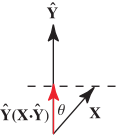
For  , let
, let  be the unit vector
in its direction. The scalar projection of
be the unit vector
in its direction. The scalar projection of  onto this direction is
 |
(2)
|
For nonzero  ,
this equals
,
this equals  .
Thus,
.
Thus,  is the scalar projection multiplied by
  , not the projection
length alone. The vector projection, shown in
red in the illustration, is
, not the projection
length alone. The vector projection, shown in
red in the illustration, is
 |
(3)
|
and its length is  .
The scalar projection is negative when
.
The scalar projection is negative when  is an obtuse
angle, whereas the length is always nonnegative. For example, the projection
of
is an obtuse
angle, whereas the length is always nonnegative. For example, the projection
of  onto
onto  is
is  and has length 4, but
  . Interchanging the vectors
changes the projection but leaves the dot product
unchanged.
. Interchanging the vectors
changes the projection but leaves the dot product
unchanged.
By writing
 |  |  |
(4)
|
 |  |  |
(5)
|
it follows that (1) yields
 |  |  |
(6)
|
 |  |  |
(7)
|
 |  |  |
(8)
|
 |  |  |
(9)
|
So, in general,
 |  |  |
(10)
|
 |  |  |
(11)
|
This can be written very succinctly using Einstein summation notation as
 |
(12)
|
The dot product is implemented in the Wolfram Language as Dot[a, b], or simply by using a period, a . b.
The dot product is commutative
 |
(13)
|
and distributive
 |
(14)
|
The associative property is meaningless for the dot product because  is not defined since
  is a scalar and therefore cannot itself be dotted. However,
it does satisfy the property
is a scalar and therefore cannot itself be dotted. However,
it does satisfy the property
 |
(15)
|
for  a scalar.
The derivative of a dot product of vectors is
![d/(dt)[r_1(t)·r_2(t)]=r_1(t)·(dr_2)/(dt)+(dr_1)/(dt)·r_2(t).](/images/equations/DotProduct/NumberedEquation8.svg) |
(16)
|
The dot product is invariant under rotations
 |  |  |
(17)
|
 |  |  |
(18)
|
 |  |  |
(19)
|
 |  |  |
(20)
|
 |  |  |
(21)
|
 |  |  |
(22)
|
where Einstein summation has been used.
The dot product is also called the scalar product and inner product. In the latter context, it is usually written  . The dot product is also defined for tensors
  and
and  by
by
 |
(23)
|
So for four-vectors  and
and  , it is defined by
 |  |  |
(24)
|
 |  |  |
(25)
|
 |  |  |
(26)
|
where  is the usual three-dimensional dot product.
