


When discussing a rotation, there are two possible conventions: rotation of the axes, and rotation of the object relative to fixed axes.
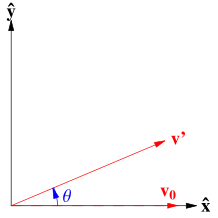
In  ,
consider the matrix that rotates a given vector
,
consider the matrix that rotates a given vector  by a counterclockwise angle
  in a fixed coordinate system. Then
![R_theta=[costheta -sintheta; sintheta costheta],](/images/equations/RotationMatrix/NumberedEquation1.svg) |
(1)
|
so
 |
(2)
|
This is the convention used by the Wolfram Language command RotationMatrix[theta].
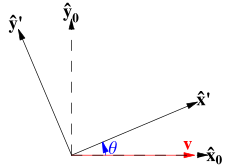
On the other hand, consider the matrix that rotates the coordinate system through a counterclockwise angle  . The coordinates of the fixed vector
  in the rotated coordinate system are now given by a rotation
matrix which is the transpose of the fixed-axis matrix
and, as can be seen in the above diagram, is equivalent to rotating the vector
by a counterclockwise angle of
in the rotated coordinate system are now given by a rotation
matrix which is the transpose of the fixed-axis matrix
and, as can be seen in the above diagram, is equivalent to rotating the vector
by a counterclockwise angle of  relative to a fixed set of axes, giving
![R_theta^'=[costheta sintheta; -sintheta costheta].](/images/equations/RotationMatrix/NumberedEquation3.svg) |
(3)
|
This is the convention commonly used in textbooks such as Arfken (1985, p. 195).
In  ,
coordinate system rotations of the x-, y-,
and z-axes in a counterclockwise direction when
looking towards the origin give the matrices
,
coordinate system rotations of the x-, y-,
and z-axes in a counterclockwise direction when
looking towards the origin give the matrices
 |  | ![[1 0 0; 0 cosalpha sinalpha; 0 -sinalpha cosalpha]](/images/equations/RotationMatrix/Inline10.svg) |
(4)
|
 |  | ![[cosbeta 0 -sinbeta; 0 1 0; sinbeta 0 cosbeta]](/images/equations/RotationMatrix/Inline13.svg) |
(5)
|
 |  | ![[cosgamma singamma 0; -singamma cosgamma 0; 0 0 1]](/images/equations/RotationMatrix/Inline16.svg) |
(6)
|
(Goldstein 1980, pp. 146-147 and 608; Arfken 1985, pp. 199-200).
Any rotation can be given as a composition of rotations about three axes (Euler's rotation theorem),
and thus can be represented by a  matrix operating on a vector,
![[x_1^'; x_2^'; x_3^']=[a_(11) a_(12) a_(13); a_(21) a_(22) a_(23); a_(31) a_(32) a_(33)][x_1; x_2; x_3].](/images/equations/RotationMatrix/NumberedEquation4.svg) |
(7)
|
We wish to place conditions on this matrix so that it is consistent with an orthogonal transformation (basically, a rotation or improper rotation).
In a rotation, a vector must keep its original length, so it must be true that
 |
(8)
|
for  ,
2, 3, where Einstein summation is being used.
Therefore, from the transformation equation,
,
2, 3, where Einstein summation is being used.
Therefore, from the transformation equation,
 |
(9)
|
This can be rearranged to
 |  |  |
(10)
|
 |  |  |
(11)
|
 |  |  |
(12)
|
In order for this to hold, it must be true that
 |
(13)
|
for  ,
2, 3, where
,
2, 3, where  is the Kronecker delta. This is known as the orthogonality condition, and it guarantees
that
is the Kronecker delta. This is known as the orthogonality condition, and it guarantees
that
 |
(14)
|
and
 |
(15)
|
where  is the transpose and
  is the identity matrix.
Equation (15) is the identity which gives the orthogonal matrix
its name. Orthogonal matrices have special properties which allow them to be manipulated
and identified with particular ease.
is the identity matrix.
Equation (15) is the identity which gives the orthogonal matrix
its name. Orthogonal matrices have special properties which allow them to be manipulated
and identified with particular ease.
Let  and
and  be two orthogonal matrices. By the orthogonality
condition, they satisfy
be two orthogonal matrices. By the orthogonality
condition, they satisfy
 |
(16)
|
and
 |
(17)
|
where  is the Kronecker delta. Now
 |  |  |
(18)
|
 |  |  |
(19)
|
 |  |  |
(20)
|
 |  |  |
(21)
|
 |  |  |
(22)
|
 |  |  |
(23)
|
so the product  of two orthogonal matrices is also orthogonal.
The eigenvalues of an orthogonal rotation matrix must satisfy one of the following:
1. All eigenvalues are 1.
2. One eigenvalue is 1 and the other two are  .
.
3. One eigenvalue is 1 and the other two are complex conjugates of the form  and
and  .
.
An orthogonal matrix  is classified as proper (corresponding to pure rotation)
if
is classified as proper (corresponding to pure rotation)
if
 |
(24)
|
where  is the determinant of
  , or improper (corresponding to inversion with possible rotation;
improper rotation) if
, or improper (corresponding to inversion with possible rotation;
improper rotation) if
 |
(25)
|
