

A matrix function  extends a scalar function
 to a square complex matrix
 through its Jordan
canonical form (Higham 2008). Suppose
 is analytic on an
open set containing all eigenvalues
of
 . For a Jordan block
 of size
 , where
 is the identity matrix
and
 , define
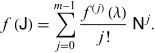 |
If  is a Jordan matrix decomposition, apply
this rule to each Jordan block and set
 . The result is independent of the choice
of Jordan basis. For a diagonalizable
matrix, only the values
 at its eigenvalues
are needed. Nontrivial Jordan blocks also require
derivatives.
Equivalently, the Cauchy integral formula gives
 |
where  consists of positively oriented, piecewise smooth, simple closed contours
with disjoint interiors enclosing all eigenvalues,
and
 is analytic on and inside each contour
(Higham 2008, 2020). The matrix
 is the resolvent
operator of
 . This construction is a finite-dimensional
functional calculus. For a scalar polynomial,
it agrees with substitution of matrix powers. The
choice
 gives the matrix exponential.
