

Mantel's theorem (Mantel 1907) states that every triangle-free graph  on
on  graph vertices has edge count
  satisfying
![m<=|_(n^2)/4_|=|_n/2_|[n/2].](/images/equations/MantelsTheorem/NumberedEquation1.svg) |
Here  and
and ![[x]](/images/equations/MantelsTheorem/Inline5.svg) denote the floor function and ceiling
function, respectively. Equivalently, every graph on
denote the floor function and ceiling
function, respectively. Equivalently, every graph on
 graph vertices
with more than
graph vertices
with more than  graph edges contains a triangle.
The bound is attained uniquely up to graph isomorphism by the complete bipartite graph ![K_(|_n/2_|,[n/2])](/images/equations/MantelsTheorem/Inline8.svg) , whose two parts differ in size by at most
one (Bollobás 1998). In the notation of extremal
graph theory, if
, whose two parts differ in size by at most
one (Bollobás 1998). In the notation of extremal
graph theory, if  denotes the maximum number of graph
edges in a graph on
denotes the maximum number of graph
edges in a graph on  graph vertices containing
no subgraph isomorphic
to
graph vertices containing
no subgraph isomorphic
to  ,
then
,
then
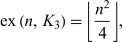 |
where  is the complete graph on three graph
vertices.
is the complete graph on three graph
vertices.
Mantel's theorem is the  case of Turán's theorem,
and the extremal graph is the Turán
graph
case of Turán's theorem,
and the extremal graph is the Turán
graph  .
.
