


A magic configuration is a finite set of points in the plane that can be assigned positive weights so that each line through at least two of the points has the same total weight. If there are at least two points, the weights can be scaled so that this common sum is 1.
Ackerman et al. (2008) proved Murty's conjecture classifying magic configurations. A point set is magic precisely when it is collinear, has no three collinear points, forms a near-pencil with a single point off the common line, or forms a seven-point failed Fano configuration.
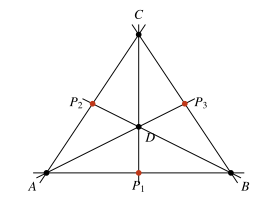
In the figure,  ,
 ,
 , and
 are the original points, and
 ,
 , and
 are the intersections of the three pairs of opposite lines.
A failed Fano configuration consists of the four points of a complete quadrangle together with its
three diagonal points, all in the affine plane.
In the real plane, the diagonal
points are noncollinear. The six side lines each contain
two original points and one diagonal
point. The three lines joining pairs of diagonal
points are ordinary lines. Weights  on the four original points and
 on the three diagonal points give a sum
of 1 on each of these nine lines. In the Fano
plane, the corresponding diagonal triple lies on a single line.
The classification is problem 735 in the Erdős problems collection. Formal Conjectures (2026) links a formal statement in Lean and a Lean proof attributed to Codex and GPT-5.6 Sol (Lean Proofs 2026).
