

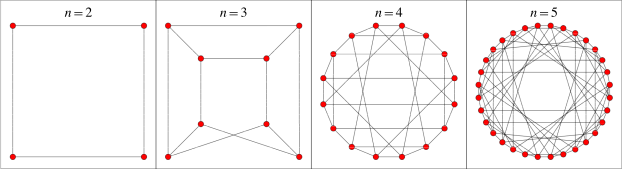
The  -dimensional
locally twisted cube graph
 , for
 , is a graph constructed recursively
from the square graph by joining two copies of the
preceding graph with a specified perfect
matching (Yang et al. 2005). It is a variant of the hypercube
graph
 with the same vertex count, edge
count, and vertex degree, but a smaller graph
diameter for
 .
Label the vertices by binary strings of length  . Start with
 , labeled so that two vertices
are adjacent when their labels differ in a single
bit. For
 ,
prefix the labels of two disjoint copies of
 with 0 and 1, respectively. Retain all edges
within the copies and add edges of the form
 |
(1)
|
where  denotes XOR, or addition modulo 2. Thus the last bit determines
whether the second bit changes along an edge joining
the copies. Equivalently, number the bit positions from left to right. The neighbors
of a label are obtained by flipping either of its last two bits separately, or by
flipping bit
 and adding the last bit modulo 2 to bit
 , for
 (Hu et al. 2007, p. 4). In particular,
labels of adjacent vertices differ in at most
two consecutive positions. The specified perfect
matching distinguishes this family from other twisting rules for hypercube
graphs (Hu et al. 2007, pp. 1-4).
The construction gives a connected graph with  vertices and
 edges. Each vertex
has vertex degree
 , and the vertex connectivity
is also
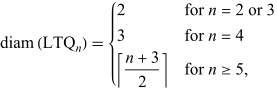
 (Yang et al. 2005). Its graph diameter is
 |
(2)
|
where  is the ceiling function (Yang et al. 2005,
Ma and Xu 2006). This is roughly half the graph diameter
 of
 .
The first members are identified in the following table up to graph
isomorphism.
 | locally twisted cube graph |
| 2 | square
graph  |
| 3 | Wagner graph |
The graphs are triangle-free, but for  they contain cycles of every length from 4 through
 (Yang et al. 2004). Consequently they are not bipartite
for
 ,
in contrast to hypercube graphs. They are also
Hamilton-connected for
 , so every two distinct vertices
are endpoints of a Hamiltonian path (Yang et
al. 2004, Ma and Xu 2006). Hu et al. (2007, p. 5) proved the stronger
property that, for
 , every edge lies on a
graph cycle of each length from 4 through
 .
General crossing-number bounds were obtained by Wang et al. (2011), with a published upper
bound in Wang et al. (2017). The following table gives exact graph
crossing numbers or upper bounds for  .
 | crossing number | reference |
| 2 | 0 | Wang et al. (2013) |
| 3 | 1 | Wang et al. (2013) |
| 4 | 10 | Wang et al. (2013) |
| 5 |  | Zhao et al. (2018, pp. 411, 417) |
| 6 |  | E. Weisstein (Nov. 2026) |
| 7 |  | Zhao et al. (2018, pp. 411, 417) |
| 8 |  | Zhao et al. (2018, pp. 411, 417) |
| 9 |  | Zhao et al. (2018, pp. 411, 417) |
| 10 |  | Zhao et al. (2018, pp. 411, 417) |
For small  ,
the
 -dimensional
locally twisted cube graph will be implemented in a future version of the Wolfram
Language as GraphData[
 "LocallyTwistedCube",
n
 ].

 ."
Disc. Appl. Math. 247, 407-418, 2018.