

The local antimagic chromatic number  of a graph
 is the minimum number of distinct induced vertex labels among
all local antimagic labelings of
 (Arumugam et al. 2017). It is defined whenever
 admits such a labeling.
Since each local antimagic labeling induces a proper coloring,
 |
(1)
|
where  is the chromatic number and
 is the vertex set of
 .
The two chromatic numbers need not be equal. For the graph disjoint union of three triangle graphs,
 |
(2)
|
whereas  (Chan et al. 2026, p. 255). The graph edge
labels must be distinct across all three connected
components, even though graph vertices in different
components may have the same induced color.
For a connected graph  with at least three vertices
and
 leaves (vertices of vertex
degree 1),
 |
(3)
|
This bound is sharp, with equality for star graphs (Lau et al. 2020, p. 1345).
For the complete bipartite graph  with
 and
 (Lau et al. 2020, p. 1353),
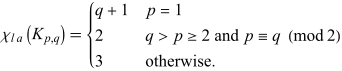 |
(4)
|
The leaf lower bound does not extend to a universal leaf-plus-two upper bound for trees. Brondani and França (2026) constructed a caterpillar graph with 40 leaves and 43 vertices
for which  . More generally, for every integer
 ,
they constructed infinitely many caterpillar graphs
with exactly
 nonleaf vertices and
 |
(5)
|
where  is the number of leaves. Consequently,
 is unbounded even among caterpillar
graphs (Brondani and França 2026).
