

A local antimagic labeling of a finite simple graph  with
 edges is a bijection
 for which adjacent vertices have distinct induced
labels (Arumugam et al. 2017). The induced label of a vertex
 is
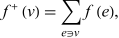 |
where the sum runs over the edges incident to  .
The induced labels give a proper coloring of the vertices. The minimum number of colors obtainable in this way is the local antimagic chromatic number. In contrast, an antimagic graph requires the induced labels at all vertices to be distinct, including nonadjacent pairs.
A graph admitting a local antimagic labeling is called a local antimagic graph. Every connected
graph with at least three vertices admits a local
antimagic labeling (Haslegrave 2018). The complete
graph  does not, since its two vertices receive the same
label from their single edge.
