Kabsch, W. "A Solution for the Best Rotation to Relate Two Sets of Vectors." Acta Cryst. A32, 922-923, 1976. https://doi.org/10.1107/S0567739476001873.Kabsch,
W. "A Discussion of the Solution for the Best Rotation to Relate Two Sets of
Vectors." Acta Cryst. A34, 827-828, 1978. https://doi.org/10.1107/S0567739478001680.Lawrence,
J.; Bernal, J.; and Witzgall, C. "A Purely Algebraic Justification of the Kabsch-Umeyama
Algorithm." J. Res. Natl. Inst. Stand. Technol.124, 124028, 2019.
https://doi.org/10.6028/jres.124.028.Umeyama,
S. "Least-Squares Estimation of Transformation Parameters Between Two Point
Patterns." IEEE Trans. Pattern Anal. Mach. Intell.13, 376-380,
1991. https://doi.org/10.1109/34.88573.


 and
and  in
in  , the Kabsch algorithm finds the orientation-preserving rigid motion
  that minimizes the sum of squared distances
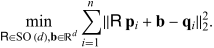


 and
and  be the matrices whose
  th
columns are
th
columns are  and
and  ,
respectively. Compute the singular value
decomposition
,
respectively. Compute the singular value
decomposition




 ,
the last entry of
,
the last entry of  prevents a reflection (Kabsch 1976, Kabsch 1978, Lawrence
et al. 2019).
prevents a reflection (Kabsch 1976, Kabsch 1978, Lawrence
et al. 2019).
