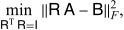
For real matrices  , the orthogonal Procrustes problem is the
least squares problem
, the orthogonal Procrustes problem is the
least squares problem
 |
(1)
|
where  is the Frobenius norm. On writing
 |
(2)
|
as a singular value decomposition,
expanding the squared Frobenius norm gives
 |
(3)
|
Maximizing the matrix trace therefore gives an optimizer
 |
(4)
|
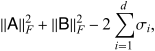
and minimum value
 |
(5)
|
where  are the singular values of
  in nonincreasing order. If
  is a nonsingular matrix,
the optimizer is unique; if it is a singular matrix,
the optimizer need not be unique (Schönemann 1966).
is a nonsingular matrix,
the optimizer is unique; if it is a singular matrix,
the optimizer need not be unique (Schönemann 1966).
For the constrained problem in which  must be a proper rotation, define
 |
(6)
|
Then  is a solution. Applied to centered point sets, this
construction is the Kabsch algorithm.
is a solution. Applied to centered point sets, this
construction is the Kabsch algorithm.
See also
Frobenius Norm,
Kabsch Algorithm,
Least Squares Fitting,
Orthogonal Matrix,
Polar
Decomposition,
Singular Value Decomposition,
Special Orthogonal Group
Explore with Wolfram|Alpha
References
Gower, J. C. and Dijksterhuis, G. B. Ch. 4 in Procrustes
Problems. Oxford, England: Oxford University Press, 2004. https://doi.org/10.1093/acprof:oso/9780198510581.001.0001.Lawrence,
J.; Bernal, J.; and Witzgall, C. "A Purely Algebraic Justification of the Kabsch-Umeyama
Algorithm." J. Res. Natl. Inst. Stand. Technol. 124, 124028, 2019.
https://doi.org/10.6028/jres.124.028.Schönemann,
P. H. "A Generalized Solution of the Orthogonal Procrustes Problem."
Psychometrika 31, 1-10, 1966. https://doi.org/10.1007/BF02289451.
Cite this as:
Weisstein, Eric W. "Orthogonal Procrustes Problem."
From MathWorld--A Wolfram Resource. https://mathworld.wolfram.com/OrthogonalProcrustesProblem.html
Subject classifications


