

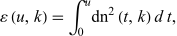
The Jacobi epsilon function is the integral of the square of the Jacobi elliptic function  ,
 |
(1)
|
initially for real  and
 , with continuation
to other arguments where defined. Here
 is the elliptic modulus.
In terms of the Jacobi amplitude,
 |
(2)
|
where  is the elliptic integral of the second
kind (NIST DLMF, §22.16(ii)). Unlike the Jacobi
elliptic functions, it is not doubly periodic.
It is related to the Jacobi zeta function by
 |
(3)
|
where  and
 are the complete elliptic
integral of the first kind and complete
elliptic integral of the second kind, respectively. The argument on the left
is the Jacobi amplitude, in the convention used
for
 . The Wolfram
Language function JacobiEpsilon[u,
m] uses the parameter
 . The Jacobi epsilon function
also occurs in a parametrization of the Costa surface.
