The Jacobi amplitude, denoted  or
or  , is the inverse function of the elliptic
integral of the first kind. It is used in elliptic
functions and elliptic integrals and can
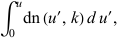
be defined by
, is the inverse function of the elliptic
integral of the first kind. It is used in elliptic
functions and elliptic integrals and can
be defined by
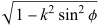
where  is a Jacobi elliptic function with elliptic modulus. As is common with Jacobi
elliptic functions, the modulus
is a Jacobi elliptic function with elliptic modulus. As is common with Jacobi
elliptic functions, the modulus  is often suppressed for conciseness. The amplitude function
is implemented in the Wolfram Language
as JacobiAmplitude[u,
m], where
is often suppressed for conciseness. The amplitude function
is implemented in the Wolfram Language
as JacobiAmplitude[u,
m], where  is the parameter.
It is related to the elliptic integral of the first kind  by
by
 |
(3)
|
(Abramowitz and Stegun 1972, p. 589).
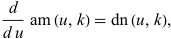
The derivative of the Jacobi amplitude is given by
 |
(4)
|
or using the notation  ,
,
 |
(5)
|
The amplitude function has the special values
where  is a complete elliptic integral
of the first kind. In addition, it obeys the identities
is a complete elliptic integral
of the first kind. In addition, it obeys the identities
which serve as definitions for the Jacobi
elliptic functions.
See also
Amplitude,
Delta Amplitude,
Elliptic Argument,
Elliptic
Characteristic,
Elliptic Function,
Elliptic
Integral of the First Kind,
Elliptic Modulus,
Jacobi Elliptic Functions,
Modular
Angle,
Nome,
Parameter
Related Wolfram sites
https://functions.wolfram.com/EllipticFunctions/JacobiAmplitude/
Explore with Wolfram|Alpha
References
Abramowitz, M. and Stegun, I. A. (Eds.). Handbook of Mathematical Functions with Formulas, Graphs, and Mathematical Tables, 9th printing.
New York: Dover, pp. 589-590, 1972.Fischer, G. (Ed.). Plate 132
in Mathematische
Modelle aus den Sammlungen von Universitäten und Museen, Bildband. Braunschweig,
Germany: Vieweg, p. 129, 1986.Gudermann, C. "Theorie der Modular-Functionen
und der Modular-Integrale." J. für Math. 18, 1-54, 1838.
https://doi.org/10.1515/crll.1838.18.1.Whittaker,
E. T. and Watson, G. N. A
Course in Modern Analysis, 4th ed. Cambridge, England: Cambridge University
Press, p. 494, 1990.Referenced on Wolfram|Alpha
Jacobi Amplitude
Cite this as:
Weisstein, Eric W. "Jacobi Amplitude."
From MathWorld--A Wolfram Resource. https://mathworld.wolfram.com/JacobiAmplitude.html
Subject classifications