

An inscribed polytope is a convex polytope whose vertices all lie on a common hypersphere. Fixing the hypersphere removes the freedom to enlarge the polytope by dilation. One extremal question asks for the largest content at a prescribed number of vertices.
In three dimensions, the unique volume maximizer with at most ten vertices on the unit sphere is an inscribed realization of the gyroelongated square dipyramid. With at most 32 vertices, it is an inscribed realization of the pentakis dodecahedron. Both uniqueness statements are up to orthogonal transformations (Hoehner 2026).
For eleven vertices, Hoehner (2026) determined that every maximizer is obtained combinatorially by contracting an edge of the icosahedron. For 13 and 15 vertices, he determined a unique possible combinatorial type, while two types remain for 16 vertices. These classifications do not determine the optimizing coordinates or exact maximum volumes.
For vertices on the unit hypersphere  , Medgyes (2026a) proved that the maximum content
with seven vertices is
 . No maximizer is a cyclic
polytope. With eight vertices, the maximum
is
 , attained uniquely, up to orthogonal
transformations, by the regular 16-cell. The proof
uses certificates from sum-of-squares
optimization checked in exact arithmetic. Medgyes
(2026a) reports AI assistance with implementation of the exact certificate computations.
With nine vertices on the unit hypersphere  , the maximum content
is
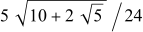 . Up to orthogonal
transformations, the unique maximizer is the convex
hull of a square and a regular
pentagon in orthogonal 2-planes through the origin. Medgyes (2026b) uses exact sum-of-squares
optimization certificates to exclude the other simplicial types.
With ten vertices on the unit hypersphere  , Medgyes (2026c) reported the maximum content
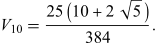 |
Up to orthogonal transformations, the unique maximizer is the convex hull of two regular pentagons in orthogonal 2-planes through the origin. The exclusion argument uses sum-of-squares optimization certificates. Most of its certificates are specified by a regeneration ledger rather than stored explicitly.

 -Polytope of Maximal Volume with Nine Vertices." 6 Nov
2026b.
 -Polytope of Maximal Volume with Ten Vertices." 10 Nov
2026c.