


|
|
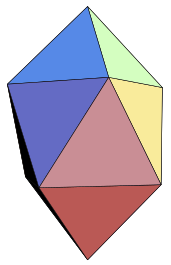
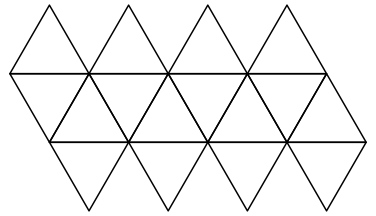
The gyroelongated square dipyramid is one of the eight convex deltahedra built up from 16 equilateral
triangles. It consists of two oppositely faced square
pyramids rotated  to each other and separated by a 4-antiprism.
It is Johnson solid
 .
If the centroid is at the origin and the sides are of unit length, the equations of the 4-antiprism give
height of the middle points
as  . Adding the height
of the square pyramids gives apex
heights of
 . The surface
area and volume of the solid are
 |  |  |
(1)
|
 |  |  |
(2)
|
 |  |  |
(3)
|

Hoehner (2026) considered the problem of maximizing volume among convex polyhedra with at most ten vertices on the unit sphere. The unique maximizer, up to orthogonal transformations, is the inscribed gyroelongated square dipyramid illustrated above. Its 16 faces are isosceles triangles of two distinct shapes: eight form the two pyramidal caps, and eight form the central antiprism belt. The faces of each type are congruent.
Its vertices consist of the two poles  and two square rings at
heights
 ,
where
 . Each ring has radius
 , and the rings are rotated
by
 relative to each other. Their polar angles are
 and
 . The full symmetry
group has group order 16 and Schönflies
symbol
 .
Its volume is
 |  |  |
(4)
|
 |  |  |
(5)
|
(OEIS A339262). Unlike  , whose vertices
lie at two distances from its center, this realization
has all ten vertices on one sphere.
