

The infinite monkey theorem states that a monkey pressing typewriter keys independently at random for an infinite amount of time will almost
surely type any prescribed finite string of characters,
and will in fact type it infinitely many times (Tassion 2025). More precisely, let
 be independent and identically
distributed random variables taking values
in a finite alphabet
be independent and identically
distributed random variables taking values
in a finite alphabet  containing at least two symbols, with
  for every
  . For a fixed string
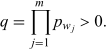
  , the probability
that one prescribed block of
, the probability
that one prescribed block of  symbols equals
  is
is
 |
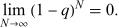
The events that  occurs in successive disjoint blocks of length
  are independent, so
the probability that it occurs in none of the first
are independent, so
the probability that it occurs in none of the first
 such blocks is
  ,
and
,
and
 |
Equivalently, the second Borel-Cantelli lemma shows that  occurs infinitely often almost surely. Since the
collection of finite strings over a finite alphabet
is countable, with probability
one every such string occurs infinitely often.
occurs infinitely often almost surely. Since the
collection of finite strings over a finite alphabet
is countable, with probability
one every such string occurs infinitely often.
The statement concerns probability one, not logical certainty. For example, the possible infinite output consisting of a single symbol repeated forever contains most strings zero times, but that output has probability zero. The theorem is related to normal numbers, but is weaker: a normal number has the correct limiting frequency for every finite digit block, whereas mere occurrence of every finite block imposes no such frequencies. The typing-monkey metaphor goes back at least to Borel (1913) and continues to be used to illustrate the cumulative effect of rare random events (Big Think 2026).
Banerji et al. (2014) gave a graph-theoretic analog. In the sequential random construction defining graph likelihood, every finite graph can be constructed and therefore has positive likelihood.
