


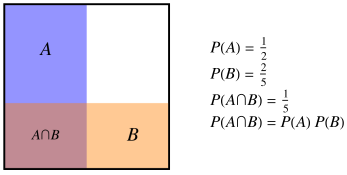
Independent events are pairs of events  and
 whose probabilities satisfy
 |
In an area model of probability, independence means that the fraction of  occupied by
 is the same as the fraction of the entire sample space
occupied by
 .
Overlap by itself does not imply dependence, and mutually
exclusive events with positive probabilities
are not independent (Papoulis 1984, p. 40).
For a finite family of events  , ...,
 , independence requires
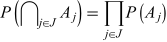 |
for every nonempty subset  of
 . Checking only pairs is insufficient. For example,
toss two fair coins independently, and let
 mean that the first toss is heads,
 that the second is heads, and
 that the outcomes agree. Each event
has probability
 , and each pair satisfies the two-event product identity.
However,
 ,
while
 ,
so the three events are not independent (Grinstead and
Snell 2006, pp. 141 and 151).
