


The cross polytope  is the regular polytope in
  dimensions corresponding to the convex
hull of the points formed by permuting the coordinates (
dimensions corresponding to the convex
hull of the points formed by permuting the coordinates ( , 0, 0, ..., 0). A cross-polytope (also called an orthoplex)
is denoted
, 0, 0, ..., 0). A cross-polytope (also called an orthoplex)
is denoted  and has
  vertices and Schläfli symbol
  . The cross polytope is named because its
 vertices are located equidistant from
the origin along the Cartesian axes in Euclidean space,
which each such axis perpendicular to all others. A cross polytope is bounded by
vertices are located equidistant from
the origin along the Cartesian axes in Euclidean space,
which each such axis perpendicular to all others. A cross polytope is bounded by

 -simplexes, and is a dipyramid erected (in both directions)
into the
-simplexes, and is a dipyramid erected (in both directions)
into the  th
dimension, with an
th
dimension, with an  -dimensional
cross polytope as its base.
-dimensional
cross polytope as its base.

|
|
|
|
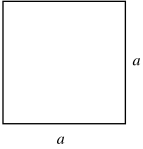
In one dimension, the cross polytope is the line segment ![[-1,1]](/images/equations/CrossPolytope/Inline12.svg) . In two dimensions, the cross polytope
. In two dimensions, the cross polytope
 is the filled square
with vertices
is the filled square
with vertices  ,
,
 ,
,  ,
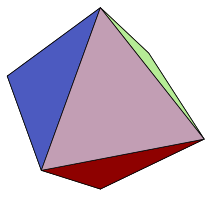
,  . In three dimensions, the cross polytope
  is the convex hull of the octahedron
with vertices
is the convex hull of the octahedron
with vertices  ,
,
 ,
,  ,
,  ,
,  ,
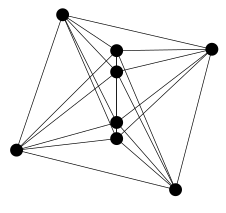
,  . In four dimensions, the cross polytope
  is the 16-cell, depicted
in the above figure by projecting onto one of the four mutually perpendicular three-spaces
within the four-space obtained by dropping one of the four vertex components (R. Towle).
is the 16-cell, depicted
in the above figure by projecting onto one of the four mutually perpendicular three-spaces
within the four-space obtained by dropping one of the four vertex components (R. Towle).
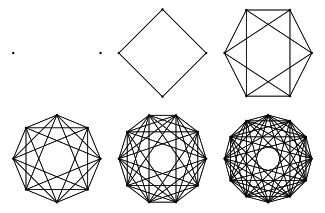
The skeleton of  is isomorphic with the circulant
graph
is isomorphic with the circulant
graph  ,
also known as the cocktail party graph
,
also known as the cocktail party graph  .
.
For all dimensions, the dual of the cross polytope is the hypercube (and vice versa). Consequently, the number of  -simplices contained in an
  -cross polytope is
  .
.

 -Space." Inst. Math. Appl. Bull. (UK) 29,
172-174, Nov./Dec. 1993.
-Space." Inst. Math. Appl. Bull. (UK) 29,
172-174, Nov./Dec. 1993.