


The Hügelschäffer egg is the closed oval component of the cubic curve
 |
(1)
|
where  ,
 , and
 are positive real numbers,
with
 . The closed oval lies in
 . The cubic
curve also has an unbounded real component with
 (Petrović and Malešević
2023).
The name honors the German engineer Fritz Hügelschäffer, who introduced the circle construction in 1944 (Petrović and Malešević 2023). It generalizes the construction of an ellipse using two concentric circles. Moving the center of the second circle along the common horizontal axis breaks the left-right symmetry and produces an egg-shaped oval. Thus the construction gives a family of shapes, rather than a single fixed egg profile. Petrović and Malešević (2023) describe its origin in aeronautical design and its use for smooth fuselage cross-sections. The name therefore describes the outline rather than a requirement to reproduce a particular bird's egg.

The circle construction illustrated above starts with  and
 , with the second center
labeled
 . For a point
 on the first circle,
take
 on the second circle where the ray
from
 through
 meets it. The point
 traces the closed component (Schmidbauer 1948, Petrović
and Malešević 2023). The gray horizontal and vertical line
segments transfer the two coordinates from
 and
 to
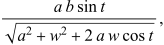
 . Equivalently, that component
has the parametric equations
 |  |  |
(2)
|
 |  |  |
(3)
|
for  .
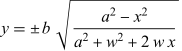
Writing
 |
(4)
|
makes both real components explicit. At  the equation factors as
 , a line
together with a parabola.
In the usual egg-shaped range  , the endpoints are
 and
 , and the maximum width
 occurs at
 . Consequently,
 controls the width-to-length ratio, while
 controls the asymmetry. A small value of
 gives a flattened profile, but this is a parameter choice
rather than an intrinsic feature of the curve. At
 , the two circles are concentric
and the profile is an ellipse. The model has also been
applied to measured chicken-egg profiles (Narushin et al. 2020).
The area enclosed by the oval is
 |
(5)
|
where  , and
 and
 are the complete
elliptic integral of the first kind and complete
elliptic integral of the second kind, respectively, in the modulus convention.
This follows by integrating the two branches over
 (Petrović and Malešević 2023).
