

Hilbert's problems are a set of (originally) unsolved problems in mathematics proposed by Hilbert. Of the 23 total appearing in the printed address, ten were actually presented at the Second International Congress in Paris on August 8, 1900. In particular, the problems presented by Hilbert were 1, 2, 6, 7, 8, 13, 16, 19, 21, and 22 (Derbyshire 2004, p. 377). Furthermore, the final list of 23 problems omitted one additional problem on proof theory (Thiele 2003).
Hilbert's problems were designed to serve as examples for the kinds of problems whose solutions would lead to the furthering of disciplines in mathematics. As such, some were areas for investigation and therefore not strictly "problems."
Consequently, the status of several items depends on how Hilbert's formulation is interpreted: some have definitive affirmative or negative answers, some are resolved only in their original setting, and others remain open-ended research programs (Browder 1976, Gray 2000, Encyclopedia of Mathematics 2026, Lamb 2026).
1. "Cantor's problem of the cardinal number of the continuum." The continuum hypothesis asks whether there is a cardinal number strictly between that of the integers and that of the real numbers. Gödel and Cohen proved that the hypothesis can neither be disproved nor proved, respectively, from the usual Zermelo-Fraenkel axioms with the axiom of choice, assuming those axioms are consistent. Status. Resolved as an independence result, although additional set-theoretic axioms continue to be studied.
2. "The compatibility of the arithmetical axioms." Hilbert sought a finitary proof that arithmetic is consistent. Gödel's second incompleteness theorem shows that a sufficiently strong consistent formal system cannot prove its own consistency. Gentzen later proved the consistency of arithmetic using transfinite induction, a method stronger than Hilbert's intended finitary means. Status. Hilbert's original program cannot be carried out as stated, although relative consistency proofs remain fundamental.
3. "The equality of the volumes of two tetrahedra of equal bases and equal altitudes." Hilbert asked whether equal-volume polyhedra are necessarily scissors congruent. Dehn (1900, 1902) constructed an invariant showing that a regular tetrahedron and a cube of the same volume are not scissors congruent. Status. Resolved negatively; this was the first of Hilbert's problems to be settled.
4. "The straight line as the shortest distance between two points." This asks for geometries in which straight lines are geodesics while some Euclidean axioms are weakened. Work of Hamel and later Pogorelov solved major precise interpretations, but Hilbert's broad wording admits several readings. Status. Substantially resolved under standard formulations.
5. "Lie's concept of a continuous group of transformations without the assumption of differentiability." Gleason, Montgomery, and Zippin proved that every locally Euclidean topological group is a Lie group. Status. Resolved in the intended finite-dimensional setting; more general analogues remain active.
6. "Mathematical treatment of the axioms of physics." Hilbert called for rigorous axiomatizations of physical theories and, in particular, for links between atomistic and continuum descriptions. Many theories have been axiomatized and important limiting relations established, but no single axiomatization encompasses physics. Status. Partially resolved and open-ended.
7. "Irrationality and transcendence of certain numbers." If  is algebraic with
  and
and  is algebraic and irrational, is
  transcendental? Gelfond's
theorem, proved independently by Gelfond and Schneider in 1934, answers yes.
It includes the transcendence of
transcendental? Gelfond's
theorem, proved independently by Gelfond and Schneider in 1934, answers yes.
It includes the transcendence of  and
and  . Status. Resolved.
8. "Problems of prime numbers." This group includes the Riemann hypothesis, the Goldbach conjecture, and related questions about prime numbers. Status. Unresolved; the Riemann hypothesis remains open.
9. "Proof of the most general law of reciprocity in any number field." Artin's reciprocity theorem solved the classical abelian version and became a foundation of class field theory; nonabelian generalizations belong to the Langlands program. Status. Resolved in the abelian setting and open in broader nonabelian forms.
10. "Determination of the solvability of a Diophantine equation." Does there exist a universal algorithm for solving Diophantine
equations? The impossibility of obtaining a general solution was proven by Yuri
Matiyasevich in 1970 (Matiyasevich 1970, Davis 1973, Davis and Hersh 1973, Davis
1982, Matiyasevich 1993) by showing that the relation  (where
  is the
  th Fibonacci number)
is Diophantine. More specifically, Matiyasevich showed that there is a polynomial
th Fibonacci number)
is Diophantine. More specifically, Matiyasevich showed that there is a polynomial
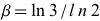 in
in  ,
,
 ,
and a number of other variables
,
and a number of other variables  ,
,  ,
,  , ... having the property that
  iff there exist integers
  ,
,  ,
,  , ... such that
  . Status. Resolved negatively.
11. "Quadratic forms with any algebraic numerical coefficients." Hilbert asked for a classification of quadratic forms over number fields. The Hasse-Minkowski theorem reduces the global problem to local ones and resolves a central part of the question, while related classification problems continue. Status. Partially resolved.
12. "Extension of Kronecker's theorem on Abelian fields to any algebraic realm of rationality." The problem asks for explicit generators of abelian extensions of arbitrary number fields, analogous to roots of unity and special values of elliptic functions in the known cases. Status. Unresolved in general; this is often called Kronecker's Jugendtraum (Holzapfel 1995).
13. "Impossibility of the solution of the general equation of the seventh degree by means of functions of only two variables." Kolmogorov and Arnold proved that every continuous multivariable function is a superposition of continuous functions of two variables, so the representation is possible in the continuous setting. Hilbert's algebraic version remains open. Status. Resolved for continuous functions, unresolved in the algebraic setting.
14. "Proof of the finiteness of certain complete systems of functions." Hilbert asked whether a certain intersection of a field of rational functions with a polynomial ring must be finitely generated. Nagata constructed a counterexample in 1959. Status. Resolved negatively, with important positive results under additional hypotheses.
15. "Rigorous foundation of Schubert's enumerative calculus." Modern intersection theory supplies rigorous foundations for a large part of enumerative geometry, but the original request was programmatic and has no universally agreed endpoint. Status. Substantially resolved, with continuing work on broader formulations.
16. "Problem of the topology of algebraic curves and surfaces." The first part concerns possible topological configurations of real algebraic curves and surfaces. The second asks for bounds on the number and arrangement of limit cycles of planar polynomial vector fields. Many special cases are known, but neither part is complete in general (Gudkov and Utkin 1978, Ilyashenko and Yakovenko 1995). Status. Unresolved.
17. "Expression of definite forms by squares." Artin proved in 1927 that every real polynomial which is nonnegative on all real inputs is a sum of squares of rational functions. Status. Resolved.
18. "Building up of space from congruent polyhedra." The problem has three parts, concerning crystallographic groups, anisohedral tilings, and the densest packing of congruent spheres. The intended questions were resolved through work of Bieberbach, Reinhardt, and Hales, respectively, although general tiling and packing questions remain active. Status. Resolved in its original principal formulations.
19. "Are the solutions of regular problems in the calculus of variations always necessarily analytic?" Regularity and analyticity theorems for the relevant elliptic equations were established by Bernstein, Petrovsky, De Giorgi, Nash, and others. Status. Generally regarded as resolved affirmatively under the intended regularity hypotheses.
20. "The general problem of boundary values." Hilbert asked for broad existence theorems for boundary value problems. The twentieth century produced extensive existence and generalized-solution theories, but the wording encompasses no single finite theorem. Status. Substantially resolved in many major classes and open-ended in general.
21. "Proof of the existence of linear differential equations having a prescribed monodromy group." In its strict form, requiring a Fuchsian system with prescribed singularities on the trivial bundle, the assertion is false by counterexamples of Bolibrukh. It becomes true if apparent singularities or more general vector bundles are allowed (Anosov and Bolibrukh 1994). Status. Resolved, with the answer depending on the precise formulation.
22. "Uniformization of analytic relations by means of automorphic functions." Koebe and Poincaré proved the uniformization theorem for Riemann surfaces in 1907. Higher-dimensional analogues do not admit a comparable general solution. Status. Resolved in the original one-dimensional setting; broader generalizations remain open.
23. "Further development of the methods of the calculus of variations." This was a call for continued development rather than a yes-or-no question, and it stimulated a vast body of work. Status. Open-ended research program with no single completion criterion.
