

The heat trace of a nonnegative self-adjoint operator  on a Hilbert space is the
operator trace
 |
(1)
|
for  such that
 is a trace-class
operator. When
 has a complete orthonormal basis of eigenvectors
with eigenvalues
 ,
 , ..., counted with multiplicity,
this is
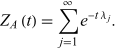 |
(2)
|
For the Laplacian  on a bounded region
 with smooth boundary and Dirichlet
boundary conditions, take
 so that its eigenvalues
are positive. The sum then converges
for every
 (Vassilevich 2003).
For  , the asymptotic
expansion as
 is
 |
(3)
|
where  is the volume,
 is the surface
area of the boundary, and
 is its integrated mean
curvature. Here
 ,
with principal curvatures chosen positive
on a sphere (Branson and Gilkey 1990, Vassilevich 2003).
Consequently these three geometric quantities are determined by the full sequence
of eigenvalues, including multiplicities.
The leading coefficient agrees with Weyl's law, while
the additional coefficients describe geometric information beyond the leading growth
of the counting function.
