TOPICS
Search

Harris Matrix


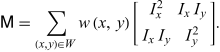
The Harris matrix is the 2×2 structure tensor used in image corner detection. For a real-valued image I(x,y), let I_x and I_y be its partial derivatives and let w be nonnegative weights on a neighborhood W. The Harris matrix is

 M=sum_((x,y) in W)w(x,y)[I_x^2 I_xI_y; I_xI_y I_y^2].

It is a real symmetric matrix and a positive semidefinite matrix, since it is a nonnegatively weighted sum of outer products of gradient vectors.

Its two eigenvalues measure intensity variation in two perpendicular directions. Two large eigenvalues indicate a corner, one large and one small eigenvalue indicate an edge, and two small eigenvalues indicate a nearly uniform region. Harris and Stephens (1988) use the response

 R=det(M)-k[Tr(M)]^2,

where 0<k<1/4 is a parameter, det is the determinant, and Tr is the matrix trace.


See also

Positive Semidefinite Matrix, Real Symmetric Matrix, Structure Tensor

Explore with Wolfram|Alpha

References

Harris, C. and Stephens, M. "A Combined Corner and Edge Detector." In Proc. Alvey Vision Conference (Ed. C. J. Taylor). Manchester, England: Alvey Vision Club, pp. 147-151, 1988. https://doi.org/10.5244/C.2.23.MathWorks. "Harris Corner Detection." MATLAB and Simulink Documentation. https://www.mathworks.com/help/visionhdl/ug/corner-detection.html.

Cite this as:

Weisstein, Eric W. "Harris Matrix." From MathWorld--A Wolfram Resource. https://mathworld.wolfram.com/HarrisMatrix.html

Subject classifications