

A graph spectral distance measures the difference between the ordered adjacency spectra of two graphs with the same vertex
count. If  and similarly for
 , two standard choices are
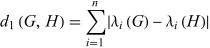 |
and
 |
These are the taxicab metric and Euclidean metric on the eigenvalue lists. Both vanish for cospectral graphs, even when the graphs are not isomorphic, so neither distinguishes all graph isomorphism classes.
Minimizing these distances over nonisomorphic graphs of the same vertex count measures how closely another
graph can approximate a given graph
spectrum. Jovanović et al. (2026) use the squared Euclidean quantity
 in their definition of graph cospectrality, the least spectral distance to a nonisomorphic
graph. They disprove two conjectured minimizers for complete tripartite graphs.
