


The Goedgebeur graph is the cubic bipartite graph on 30 vertices found by computer search
by Goedgebeur (2015). It gives a counterexample
to the conjecture of Abreu et al. (2008) that the utility
graph  ,
Heawood graph, and Pappus
graph are the only essentially 4-edge-connected pseudo 2-factor isomorphic bicubic graphs. Here, a 2-factor
is a spanning 2-regular subgraph,
i.e., a graph disjoint union of cycles
covering all vertices. A graph
is pseudo 2-factor isomorphic if all its 2-factors
have the same parity of number of cycles.
,
Heawood graph, and Pappus
graph are the only essentially 4-edge-connected pseudo 2-factor isomorphic bicubic graphs. Here, a 2-factor
is a spanning 2-regular subgraph,
i.e., a graph disjoint union of cycles
covering all vertices. A graph
is pseudo 2-factor isomorphic if all its 2-factors
have the same parity of number of cycles.
The Goedgebeur graph has 45 edges, girth 6, graph diameter 5, cyclic
edge connectivity 6, and automorphism
group of group order 144. It has 312 2-factors,
with cycle lengths  ,
,  ,
,  , and
, and  (Goedgebeur 2015).
The name was introduced by Abreu et al. (2023).
The Goedgebeur graph is also the Levi graph of the self-dual  Goedgebeur configuration.
Abreu et al. (2023) constructed the Goedgebeur graph from the Heawood graph and the Möbius-Kantor graph  , the Levi
graphs of the Fano plane and Möbius-Kantor
configuration, respectively. Aside from the Gray graph,
the Goedgebeur graph is the only other counterexample
to the pseudo 2-factor isomorphic graph conjecture reported by Abreu et al. (2025).
, the Levi
graphs of the Fano plane and Möbius-Kantor
configuration, respectively. Aside from the Gray graph,
the Goedgebeur graph is the only other counterexample
to the pseudo 2-factor isomorphic graph conjecture reported by Abreu et al. (2025).
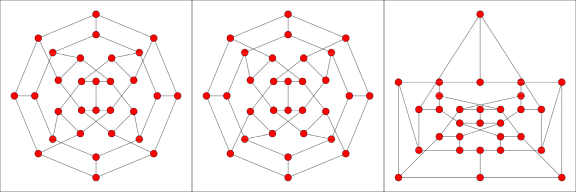
A number of minimal 8-crossing drawings of the Goedgebeur graph are illustrated above (E. Weisstein, May 2-6, 2026).
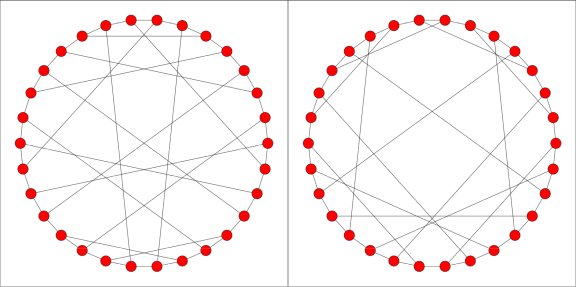
The Goedgebeur graph admits two distinct order-1 LCF notation drawings, both having bilateral symmetry, illustrated above (E. Weisstein, May 2, 2026).
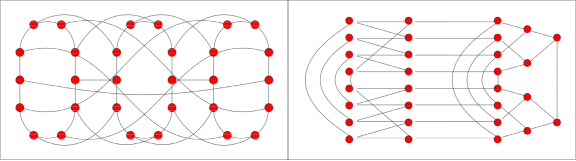
Two curved-edge drawings are illustrated above. The left drawing, due to Marién Abreu, displays the  2-factor as the three
ovals. The oval pattern suggested
a possible infinite family of analogous counterexamples,
but the corresponding construction breaks down in larger cases, underscoring the
isolated nature of the Goedgebeur graph. The right drawing is from Abreu et al.
(2023).
2-factor as the three
ovals. The oval pattern suggested
a possible infinite family of analogous counterexamples,
but the corresponding construction breaks down in larger cases, underscoring the
isolated nature of the Goedgebeur graph. The right drawing is from Abreu et al.
(2023).
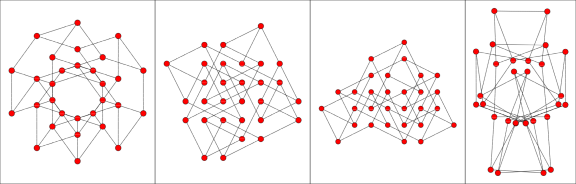
Four unit-distance embeddings of the Goedgebeur graph are illustrated above (E. Weisstein, May 2, 2026).
The Goedgebeur graph is implemented in the Wolfram Language as GraphData["GoedgebeurGraph"].
