

A generalized Euler line of a convex polygon may be defined by averaging the circumcenters, triangle centroids, and orthocenters of a cyclically selected family of triangles from the polygon vertices.
For a convex polygon with vertices  ,
,  , ...,
  , let
, let  be the triangle with vertices
 ,
,
 ,
and
,
and  for
for  ,
2, ...,
,
2, ...,  ,
where indices are interpreted modulo
,
where indices are interpreted modulo  . If
. If  ,
,  , and
, and  are respectively the circumcenter,
triangle centroid, and orthocenter
of
are respectively the circumcenter,
triangle centroid, and orthocenter
of  ,
define the averaged centers by
,
define the averaged centers by
 |  |  |
(1)
|
 |  |  |
(2)
|
 |  |  |
(3)
|
When these three averaged centers are collinear, their common line is the generalized Euler line of the polygon in this sense (Velezmoro León et al. 2026).
For every convex quadrilateral, the averaged points  ,
,
 ,
and
,
and  are collinear and so determine a generalized Euler line. In this case,
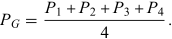 |
(4)
|
For a cyclic polygon,  is the circumcenter of
the polygon, so any nondegenerate generalized Euler line passes through the circumcenter.
For an isosceles trapezoid, the generalized
Euler line is the axis of symmetry; for a right trapezoid,
it is perpendicular to the parallel sides and splits the trapezoid into two equal-area
pieces.
is the circumcenter of
the polygon, so any nondegenerate generalized Euler line passes through the circumcenter.
For an isosceles trapezoid, the generalized
Euler line is the axis of symmetry; for a right trapezoid,
it is perpendicular to the parallel sides and splits the trapezoid into two equal-area
pieces.
This averaged-center construction is distinct from the generalized Euler line associated with the circumcenter of mass.
