The numbers of fullerenes on ,
22, 24, ... vertices (counting enantiomers
as equivalent) are given by 1, 0, 1, 1, 2, 3, 6, 6, 15, 17, 40, 45, 89, ... (OEIS
A007894). Fullerenes can be enumerated and
generated using the programs plantri and fullgen.
While almost all small fullerenes have fractional chromatic number 5/2, those listed in the following table (indexed according
to Brinkmann and McKay) do not.
Babić, D.; Klein, D. J.; Lukovits, I.; Nikolić, S.; and Trinajstić, N. "Resistance-Distance Matrix: A Computational Algorithm
and Its Applications." Int. J. Quant. Chem.60, 161-176, 2002.Balaban,
A. T.; Liu, X.; Klein, D. J.; Babić, D.; Schmalz, T. G.; Seitz,
W. A.; and Randić, M. "Graph Invariants for Fullerenes." J.
Chem. Inf. Comput. Sci.35, 396-404, 1995.Brinkmann, G. and
Dress, W. M. "A Constructive Enumeration of Fullerenes." J. Algorithms23,
245-358, 1997.Brinkmann, G. and McKay, B. "plantri and fullgen."
https://users.cecs.anu.edu.au/~bdm/plantri/.Faulon,
J. L.; Visco, D.; and Roe, D. "Enumerating Molecule." In Reviews
in Computational Chemistry, Vol. 21 (Ed. K. Lipkowitz.) New York: Wiley-VCH,
2005.Fowler, P. W. and Manolopoulos, D. E. An
Atlas of Fullerenes. New York: Dover, 2007.Fowler, P. W.;
Manolopoulos, D. E.; and Ryan, R. P. "Isomerization of Fullerenes."
Carbon30, 1235, 1992.Godsil, C. and Royle, G. "Fullerenes."
§9.8 in Algebraic
Graph Theory. New York: Springer-Verlag, pp. 208-210, 2001.House
of Graphs. "Fullerenes." https://houseofgraphs.org/meta-directory/fullerenes.Livshits,
A. M. and Lozovik, Yu. E. "Cut-And-Unfold Approach to Fullerene Enumeration."
J. Chem. Inf. Comput. Sci.44, 1517-1520, 2004.Milicevic,
A. and Trinajstic, N. "Combinatorial Enumeration in Chemistry." Chem.
Modell.4, 405-469, 2006.Petkovšek, M. and Pisanski,
T. "Counting Disconnected Structures: Chemical Trees, Fullerenes, I-Graphs and
Others." Croatica Chem. Acta78, 563-567, 2005.Royle, G. "Fullerenes."
http://school.maths.uwa.edu.au/~gordon/remote/fullerenes/Sloane,
N. J. A. Sequence A007894 in "The
On-Line Encyclopedia of Integer Sequences."


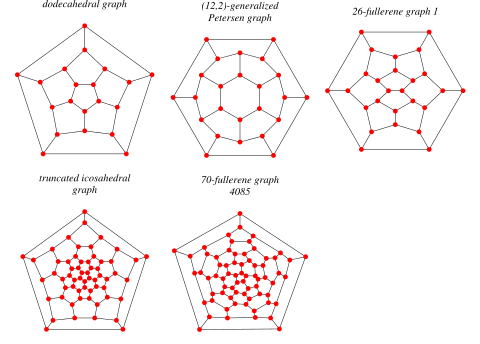
 ,
graph on 26 vertices given
by Godsil and Royle (2001, p. 208), truncated
icosahedral graph, and stable molecule
,
graph on 26 vertices given
by Godsil and Royle (2001, p. 208), truncated
icosahedral graph, and stable molecule  (Babić et al. 2002), illustrated above.
 vertices
is a regular graph of vertex
degree
vertices
is a regular graph of vertex
degree  ,
and it has precisely 12 odd chordless cycles,
all of them of length 5.
,
and it has precisely 12 odd chordless cycles,
all of them of length 5.
 ,
22, 24, ... vertices (counting enantiomers
as equivalent) are given by 1, 0, 1, 1, 2, 3, 6, 6, 15, 17, 40, 45, 89, ... (OEIS
A007894). Fullerenes can be enumerated and
generated using the programs plantri and fullgen.
,
22, 24, ... vertices (counting enantiomers
as equivalent) are given by 1, 0, 1, 1, 2, 3, 6, 6, 15, 17, 40, 45, 89, ... (OEIS
A007894). Fullerenes can be enumerated and
generated using the programs plantri and fullgen.
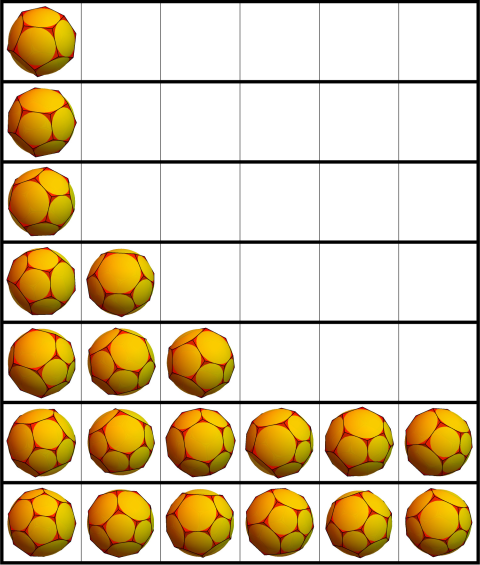
 -Goldberg
polyhedra) and type II (isomorphic to the skeletons
of
-Goldberg
polyhedra) and type II (isomorphic to the skeletons
of  -Goldberg
polyhedra) are implemented in the Wolfram
Language as BuckyballGraph[n,
"I"] and BuckyballGraph[n,
"II"], respectively.
-Goldberg
polyhedra) are implemented in the Wolfram
Language as BuckyballGraph[n,
"I"] and BuckyballGraph[n,
"II"], respectively.


