


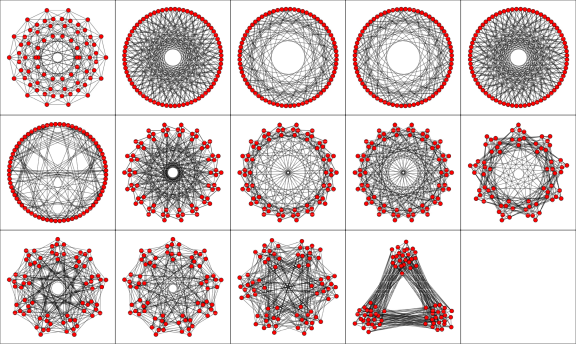
The Fricke-Macbeath graph, also called the Macbeath graph, is the 1-skeleton of the Hurwitz map  on the Fricke-Macbeath
curve, which has genus 7. It is a septic
graph with 72 vertices and 252 edges,
illustrated above in a number of drawings. The map has 168 triangular faces.
Its automorphism group has group
order 1008 (Bokowski and Cuntz 2018).
on the Fricke-Macbeath
curve, which has genus 7. It is a septic
graph with 72 vertices and 252 edges,
illustrated above in a number of drawings. The map has 168 triangular faces.
Its automorphism group has group
order 1008 (Bokowski and Cuntz 2018).
The following cyclic construction organizes an edge list and two-half decomposition supplied by E. Pegg, Jr. (pers. comm., May 20-21,
2025). Take all subscripts modulo 7 and write  for the undirected edge
with endpoints
for the undirected edge
with endpoints  and
and  .
The letters are simply orbit labels. One half with 36 vertices
consists of a fixed vertex
.
The letters are simply orbit labels. One half with 36 vertices
consists of a fixed vertex  and five families
  ,
,  ,
,  ,
,  , and
, and  with seven vertices each,
with one vertex in each family for every
with seven vertices each,
with one vertex in each family for every  modulo 7. Simultaneously replacing every subscript
  by
by  is an order-7 graph automorphism
of the half. For every
is an order-7 graph automorphism
of the half. For every  , add the edges
  ,
,  ,
,  ,
,  ,
,  ,
,  ,
,  ,
,  ,
,  ,
,  ,
,  , and
, and  . Take a disjoint isomorphic primed copy on
  ,
,  ,
,  ,
,  ,
,  , and
, and  . Join the two halves, for every
  , by the edges
  ,
,  ,
,  ,
,  ,
,  ,
,  ,
,  ,
,  ,
,  ,
,  ,
,  , and
, and  . The resulting graph
is the Fricke-Macbeath graph.
. The resulting graph
is the Fricke-Macbeath graph.
The Fricke-Macbeath graph is implemented in the Wolfram Language as GraphData["FrickeMacbeathGraph"].
The local graph at every vertex is the cycle graph  . The graph is vertex-transitive,
edge-transitive, and arc-transitive,
as well as Hamiltonian and Hamilton-connected.
. The graph is vertex-transitive,
edge-transitive, and arc-transitive,
as well as Hamiltonian and Hamilton-connected.
It has graph genus 7, girth 3, graph radius 5, graph diameter 5, chromatic number 5, edge chromatic number 7, clique number 3, and independence number 18. Its characteristic polynomial is
 |

 of Genus 7: A Polyhedral Realization."
Art Discrete Appl. Math. 1, #P1.02, 2018.
of Genus 7: A Polyhedral Realization."
Art Discrete Appl. Math. 1, #P1.02, 2018.