

A Fourier multiplier is an operator  defined by multiplying the Fourier
transform by a prescribed symbol
 ,
 |
For a bounded measurable function  and a Schwartz function
 , the inverse
Fourier transform defines
 in L2-space.
It extends to a bounded operator on that L2-space,
with operator norm equal to the essential
supremum of
 by Plancherel's theorem. Boundedness
on other Lp-spaces is a separate
question.
The symbol  gives the identity operator. The symbols
 , with
 and
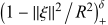 , give Bochner-Riesz
means, where
 is the positive part. The symbol
 , with
 and the angular-frequency convention, defines the operator used in a Bessel
potential space on Schwartz functions.
