

A first integral of a system of ordinary differential equations  is a nonconstant differentiable function
 that is constant along every solution. On a domain where
the solutions and derivatives exist, this condition is expressed by
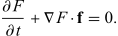 |
The chain rule then gives  . In mechanics, such a conserved quantity is
also called a constant of motion. A time-independent first integral restricts each
trajectory to a level set of
 .
For example, the system  ,
 has the first integral
 , since
 |
The nonzero trajectories therefore lie on circles. Continuous variational symmetries provide an important source of first integrals through Noether's symmetry theorem.
