

A conservation law is a relation expressing the constancy of a quantity along the evolution of a system. For ordinary differential equations, a conserved quantity is described by a first integral. For partial differential equations, a local conservation law has the form
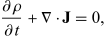 |
where  is a density and
 is its flux. The equation relates the local rate of change to the divergence
of the flux (Olver 1986).
For sufficiently regular fields on a fixed region  , the divergence theorem
yields
 |
where  is the outward unit normal vector. Thus the
integral is constant when the net boundary flux vanishes. Continuous variational
symmetries give conservation laws through Noether's
symmetry theorem. This mathematical use of the term is distinct from a claim
that every physical quantity is conserved.
