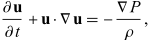
Euler's equations of inviscid motion are the system of partial differential equations describing fluid flow in the absence of viscosity, given
by
where
is the fluid velocity, is the pressure, and is the fluid density.
The regularity problem for the three-dimensional incompressible Euler equations asks whether smooth divergence-free initial data can produce finite-time
blow-up. Alpöge and Buckmaster (2026a) claim finite-time blow-up on
from smooth axisymmetric initial data with swirl and a force that is smooth in space
and time and supported in a fixed solid torus. In their
construction, the circulation and meridional velocity stay bounded, while the circulation
gradient and full vorticity become unbounded and
Buckmaster (2026) reports substantial assistance from Claude and Codex across the project. An accompanying Lean 4 development formalizes the claim, but independent human verification had not been reported as of Sep. 9, 2026 (Alpöge and Buckmaster 2026b).
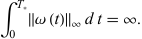
OpenAI (2026ab) announced a proposed resolution on Sep. 8, 2026. Its paper claims a smooth, divergence-free initial velocity having compact
support on whose maximal smooth solution has finite lifetime. The claimed
solution has unbounded velocity gradient and satisfies the divergent vorticity
integral condition in the Beale-Kato-Majda
criterion.


 is the fluid velocity,
  is the pressure, and
  is the fluid density.
 from smooth axisymmetric initial data with swirl and a force that is smooth in space
and time and supported in a fixed solid torus. In their
construction, the circulation and meridional velocity stay bounded, while the circulation
gradient and full vorticity become unbounded and
from smooth axisymmetric initial data with swirl and a force that is smooth in space
and time and supported in a fixed solid torus. In their
construction, the circulation and meridional velocity stay bounded, while the circulation
gradient and full vorticity become unbounded and
 whose maximal smooth solution has finite lifetime. The claimed
solution has unbounded velocity gradient and satisfies the divergent vorticity
integral condition in the Beale-Kato-Majda
criterion.
whose maximal smooth solution has finite lifetime. The claimed
solution has unbounded velocity gradient and satisfies the divergent vorticity
integral condition in the Beale-Kato-Majda
criterion.
