

A finite-time blow-up of a solution  to a time-dependent differential
equation occurs when the maximal interval of classical existence has a finite
endpoint
to a time-dependent differential
equation occurs when the maximal interval of classical existence has a finite
endpoint  and a quantity needed to continue the solution becomes unbounded as
  approaches
  from below. In a common normed
space formulation, this is expressed as
from below. In a common normed
space formulation, this is expressed as
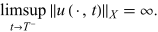 |
The relevant norm and the quantity that diverges depend on the problem; the solution itself or one of its derivatives may blow up (Galaktionov and Vázquez 2002).
For example, the solution  of the ordinary
differential equation
of the ordinary
differential equation  with
with  blows up at
  . Finite-time blow-up is distinct from an algebraic
blow-up and a graph blow-up.
. Finite-time blow-up is distinct from an algebraic
blow-up and a graph blow-up.
