


The Navier-Stokes equations are nonlinear partial differential equations governing the velocity and pressure of a viscous fluid. For an incompressible Newtonian fluid with constant density, they can be written
 |  |  |
(1)
|
 |  |  |
(2)
|
where  is the fluid velocity,
  is the pressure,
  is the constant fluid density,
  is the kinematic viscosity, and
  is the body force per unit mass. The first equation expresses
conservation of momentum, while the second is the incompressibility condition.
is the body force per unit mass. The first equation expresses
conservation of momentum, while the second is the incompressibility condition.
The nonlinear term  is the convective part of the convective
derivative. Setting
is the convective part of the convective
derivative. Setting  and
and  gives Euler's
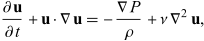
equations of inviscid motion. Taking the divergence
of the momentum equation and using incompressibility gives Poisson's
equation
gives Euler's
equations of inviscid motion. Taking the divergence
of the momentum equation and using incompressibility gives Poisson's
equation
 |
(3)
|
so the pressure is coupled to the velocity field. A particular flow problem also requires initial conditions and boundary conditions.
Leray (1934) established the global existence of weak solutions on  for divergence-free initial
velocity fields having finite
for divergence-free initial
velocity fields having finite  norm. His framework allows possible
singularities and does not establish uniqueness.
It has remained unknown whether every smooth divergence-free
initial velocity with suitable decay gives a globally
smooth solution. This existence and smoothness question is one of the Millennium
Prize Problems (Fefferman 2000).
norm. His framework allows possible
singularities and does not establish uniqueness.
It has remained unknown whether every smooth divergence-free
initial velocity with suitable decay gives a globally
smooth solution. This existence and smoothness question is one of the Millennium
Prize Problems (Fefferman 2000).
Tao (2016) constructed a smooth solution that develops finite-time blow-up for an averaged three-dimensional Navier-Stokes equation having the same energy identity and scaling as the classical equations. Since the averaging changes the convective term, this is not a singularity of the classical Navier-Stokes equations. It instead shows that a regularity proof must use finer structure in the nonlinear term than the energy identity and scaling alone.
Córdoba and Martínez-Zoroa (2023) developed an analytic, non-self-similar cascade mechanism in which infinitely many localized regions of vorticity
interact across successively smaller scales. They used it to produce blow-up for
the forced three-dimensional Euler equations, but their force had only  regularity. In a related unforced construction,
Córdoba et al. (2025) obtained a finite-time singularity with velocity
globally in
regularity. In a related unforced construction,
Córdoba et al. (2025) obtained a finite-time singularity with velocity
globally in  and smooth away from one point. These regularity limitations meant that neither result
settled the classical smooth-data problem, but the cascade mechanism supplied the
main analytic strategy for the later Euler and Navier-Stokes constructions (Kakaes
2026).
and smooth away from one point. These regularity limitations meant that neither result
settled the classical smooth-data problem, but the cascade mechanism supplied the
main analytic strategy for the later Euler and Navier-Stokes constructions (Kakaes
2026).
OpenAI (2026a, 2026c) announced a proposed resolution on Sep. 8, 2026. For every positive viscosity, the paper constructs a smooth external force having compact
support in space and time and a solution starting from rest that is smooth for
 .
Its
.
Its  norm, and hence its kinetic energy, remains uniformly bounded,
but its
norm, and hence its kinetic energy, remains uniformly bounded,
but its  velocity becomes unbounded as
  approaches 1. The paper claims that this establishes breakdown
alternatives (C) and (D) in Fefferman's official formulation, respectively on
approaches 1. The paper claims that this establishes breakdown
alternatives (C) and (D) in Fefferman's official formulation, respectively on  and the three-dimensional torus
  .
.
Alternatives (C) and (D) explicitly permit a nonzero smooth external force, whereas alternatives (A) and (B) set the force to zero. Therefore, if the proof is correct, it resolves the official problem, but does not establish finite-time singularity formation for the unforced Navier-Stokes equations. OpenAI also released a Lean 4 formalization reporting no omitted proof placeholders. Its project metadata described the review status on release as "self-assessed" (OpenAI 2026b).
The Clay Mathematics Institute (2026) responded on Sep. 11, 2026, describing the problem as "apparently" settled while emphasizing that its process for evaluating the achievement and assigning credit would proceed under the prize rules. This announcement acknowledges the claimed resolution without announcing a prize award.
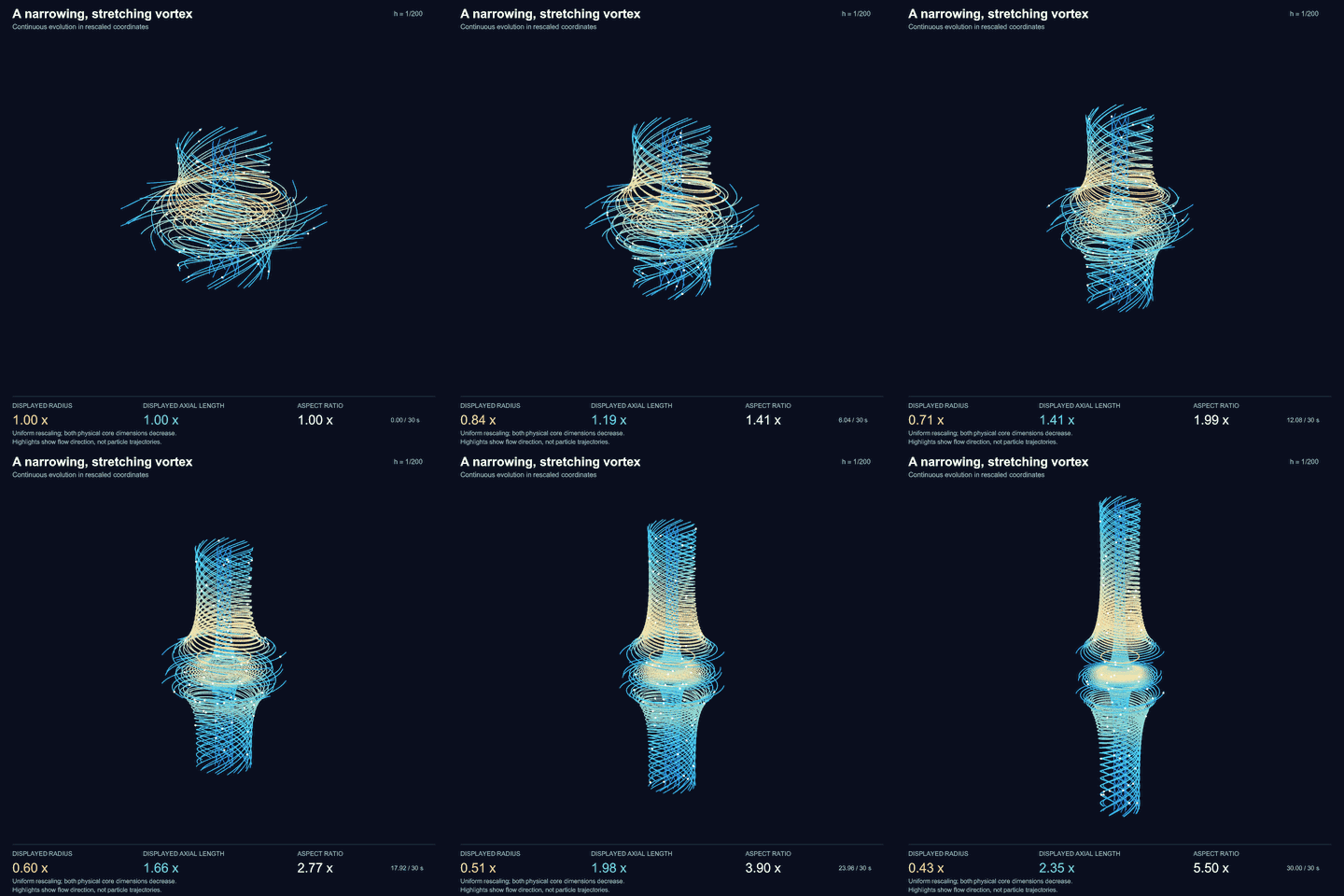
The animation above (Phadikar 2026) illustrates a concentrating vortex core in scaled coordinates using approximate equations.
The Navier-Stokes equations appear in Big Weld's office in the 2005 animated film Robots.

 Force." 15 Sep 2023.
  ."
Ann. PDE 11, Paper 19, 56 pp., 2025.
."
Ann. PDE 11, Paper 19, 56 pp., 2025.  Phadikar, J. "An Intuitive Exploration of OpenAI's Navier-Stokes Singularity
in Millennium Prize $1M Problem." Wolfram Community, Sep. 14, 2026.
Phadikar, J. "An Intuitive Exploration of OpenAI's Navier-Stokes Singularity
in Millennium Prize $1M Problem." Wolfram Community, Sep. 14, 2026.