

The Erdős distinct distances problem asks for the smallest number  of distinct positive Euclidean
distances determined by
 distinct points in the plane
(Erdős 1946). The conjectured order of growth is
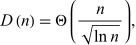 |
where  denotes asymptotic notation and
 is the natural logarithm.
A square lattice gives the upper
bound of this order.
Guth and Katz (2015) proved the lower bound  for an absolute constant
 and
 . The remaining logarithmic gap is open (Bloom
2026a). For
 , 2, ..., the exact values begin 0, 1, 1, 2, 2, 3,
3, 4, 4, 5, 5, 5, 6, ... (OEIS A186704).
This is problem 89 in the Erdős problems collection (Bloom 2026a).
A related pinned-distance question counts the distinct distances from each individual point. Problem
654(i) asks whether, for every  ,
every sufficiently large planar point set of size
 with no four concyclic points
has a point with more than
 distinct distances
to the others. Feng et al. (2026) reported a counterexample
discovered by Aletheia, using points on two perpendicular lines.
In the variant formalized by Veljjanoski (2026a), the  points are
 and
 for
 ,
with
 . A circle meets either
axis in at most two points, and a circle
through two on each axis would require equal products of its intercepts on the two
axes. The products are even and odd,
respectively. From any point there are at most
 distinct distances
to points on its own axis and at most
 to those on the other axis, by reflection
across the axis containing that point. Palomar Registry
(2026a) records kernel acceptance of the bound
 and the negative answer to part (i). The general
position variant, which also excludes collinear
triples, remains open.
A different restriction excludes isosceles triangles, including degenerate ones. The question asks whether, in each fixed dimension  , every such
 -point set
must determine at least
 distinct positive distances,
where
 (Bloom 2026b). Straus observed that no such bound can hold uniformly in the dimension.
An explicit construction takes all
 points whose
 th coordinate is either 0 or
 , for
 (Veljjanoski 2026b). The squared Euclidean
distance between two points is the sum
of
 over the coordinates where they differ. Uniqueness
of finite binary expansions
rules out an isosceles triangle, and the positive squared distances
are precisely 1, 2, ...,
 .
Palomar Registry (2026b) records kernel acceptance of this power-of-two construction.
It does not settle the question in a fixed dimension,
since
 grows with the number of points.
A separated-distance variant assumes an averaged energy bound. For  , let
 contain
 distinct points and suppose
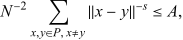 |
where  is independent of
 and
 is the Euclidean norm.
Burstein et al. (2026) obtained, for every
 , at least
 distances
whose pairwise separations are at least
 .
This is a separation-scale conclusion under an energy hypothesis, rather than a resolution
of the unrestricted logarithmic gap.

 Points." Amer. Math. Monthly 53, 248-250,
1946.