

For an ordered list  in a metric space with metric
  , the distance matrix of
  is the square matrix
 |
(1)
|
It is symmetric, has zero diagonal and nonnegative entries, and its entries obey the triangle inequality 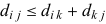 . Conversely, any matrix with these
properties and with
. Conversely, any matrix with these
properties and with  iff
iff  defines a metric on its index set. A dissimilarity matrix
need not satisfy all of these conditions.
defines a metric on its index set. A dissimilarity matrix
need not satisfy all of these conditions.
Suppose  ,
...,
,
...,  are points in a Euclidean space. The matrix of their squared distances,
 |
(2)
|
is commonly called a squared Euclidean distance matrix, or sometimes simply a Euclidean distance matrix. Let  be the all-ones vector and define
 |  |  |
(3)
|
 |  |  |
(4)
|
Then  is the gram matrix of the points after translating
their geometric centroid to the origin. A symmetric
matrix
is the gram matrix of the points after translating
their geometric centroid to the origin. A symmetric
matrix  with zero diagonal is a squared Euclidean distance matrix iff
  is positive
semidefinite; equivalently,
is positive
semidefinite; equivalently,  whenever
  (Schoenberg 1935). The smallest Euclidean dimension in
which the distances can be realized is
(Schoenberg 1935). The smallest Euclidean dimension in
which the distances can be realized is  (Young and Householder 1938). If
  contains unsquared Euclidean distances, these criteria
are applied to
contains unsquared Euclidean distances, these criteria
are applied to  .
.
If  is nonzero and the points have affine dimension
  , then
  . More precisely, the rank is
  when the points lie on a hypersphere
in their affine hull, and is
when the points lie on a hypersphere
in their affine hull, and is  otherwise (Gower 1985). Thus an affinely two-dimensional
configuration gives a squared Euclidean distance matrix of rank at most 4, with rank
3 when the points lie on a circle.
otherwise (Gower 1985). Thus an affinely two-dimensional
configuration gives a squared Euclidean distance matrix of rank at most 4, with rank
3 when the points lie on a circle.
Moreover, every nonzero squared Euclidean distance matrix has exactly one positive eigenvalue; all its other nonzero eigenvalues are negative.
A graph distance matrix is the distance matrix obtained from the graph distances among the vertices of a graph. Distance matrices also serve as input to multidimensional scaling and other methods that reconstruct or approximate point configurations from pairwise distances.
The distance matrix of a list of objects can be computed in the Wolfram Language using DistanceMatrix[ x1, ..., xn
 ], with the metric specified by the DistanceFunction
option when needed. Choosing SquaredEuclideanDistance
as the distance function produces
], with the metric specified by the DistanceFunction
option when needed. Choosing SquaredEuclideanDistance
as the distance function produces  .
.

 Alfonsi, J. "Four-Color Graphical Bioinformatics:
The Machinery behind Phylogenetic Trees." Wolfram Community, Aug. 3,
2026.
Alfonsi, J. "Four-Color Graphical Bioinformatics:
The Machinery behind Phylogenetic Trees." Wolfram Community, Aug. 3,
2026.