

Multidimensional scaling (MDS) is a family of methods that represents objects as points in a low-dimensional space so that distances between the points approximate
given pairwise dissimilarities. Given dissimilarities  , MDS seeks points
  , ...,
  whose fitted distances
 |
(1)
|
reproduce the structure of the  as closely as possible (Borg and Groenen 2005).
Classical multidimensional scaling, also called principal coordinates analysis or Torgerson scaling, starts with the matrix  and the centering matrix
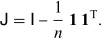 |
(2)
|
Double centering gives
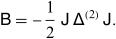 |
(3)
|
If the dissimilarities are Euclidean distances,  is a positive semidefinite
matrix and is the gram matrix of a centered realization.
If
is a positive semidefinite
matrix and is the gram matrix of a centered realization.
If  is an eigendecomposition, the coordinates in
  dimensions are obtained from the
  largest positive eigenvalues and their eigenvectors as
 |
(4)
|
The rank of  is the smallest dimension of an exact Euclidean realization.
When an exact realization in
is the smallest dimension of an exact Euclidean realization.
When an exact realization in  is impossible, truncating the eigendecomposition gives a
best rank-
is impossible, truncating the eigendecomposition gives a
best rank- positive semidefinite approximation to
  in the Frobenius norm. For
Euclidean input data, classical MDS and principal component analysis give equivalent
centered configurations up to an isometry (Young and
Householder 1938, Torgerson 1952).
in the Frobenius norm. For
Euclidean input data, classical MDS and principal component analysis give equivalent
centered configurations up to an isometry (Young and
Householder 1938, Torgerson 1952).
Metric MDS more generally finds coordinates by minimizing a stress function such as
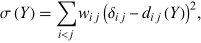 |
(5)
|
where the  are nonnegative weights. Nonmetric MDS replaces the dissimilarities by fitted values
constrained to have the same rank order, thereby attempting to preserve ordinal rather
than numerical distance information (Kruskal 1964a, 1964b).
are nonnegative weights. Nonmetric MDS replaces the dissimilarities by fitted values
constrained to have the same rank order, thereby attempting to preserve ordinal rather
than numerical distance information (Kruskal 1964a, 1964b).
MDS coordinates are not unique: translating, rotating, or reflecting a configuration preserves all of its pairwise distances. The quality and interpretation of a representation therefore depend on the target dimension and the chosen loss function, not on the orientation of its coordinate axes.
Metric multidimensional scaling is available in the Wolfram Language using DimensionReduce[data, p, Method -> "MultidimensionalScaling"].
