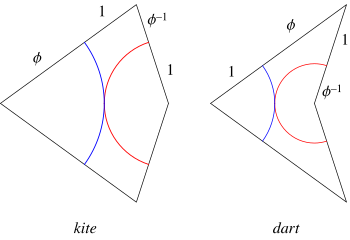
The Penrose tiles are a pair of shapes that tile the plane only aperiodically (when the markings are constrained to match at borders). These two tiles, illustrated above,
are called the "kite" and "dart," respectively. In strict Penrose
tiling, the tiles must be placed in such a way that the colored markings agree; in
particular, the two tiles may not be combined into a rhombus (Hurd).
Two additional types of Penrose tiles known as the rhombs (of which there are two varieties: fat and skinny) and the pentacles (or which there are six type) are sometimes also defined that have slightly more complicated matching conditions (McClure 2002).
In 1997, Penrose sued the Kimberly Clark Corporation over their quilted toilet paper, which allegedly resembles a Penrose aperiodic tiling (Mirsky 1997). The suit was apparently settled out of court.
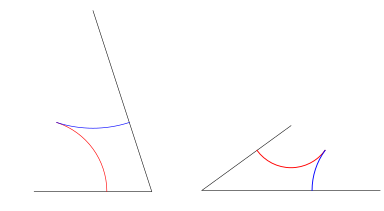
Penrose tilings are substitution tilings. Their replacement rules can be expressed as subdivisions of the triangular half-tiles
described below (Frank 2008).
To see how the plane may be tiled aperiodically using the kite and dart, divide the kite into acute and obtuse tiles, shown above (Hurd).
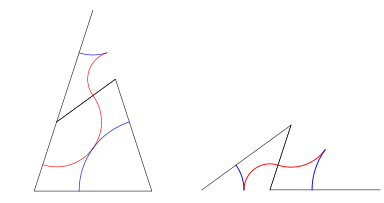
When applied to a collection of tiles, tile deflation leads to a more refined collection. The rules do not respect tile boundaries, but
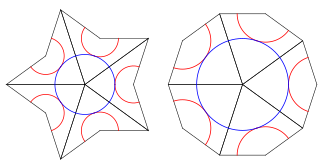
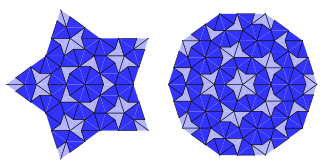
do respect the half tiles defined above. There are two ways to obtain aperiodic tilings with 5-fold symmetry about a single point. They are
known as the "star" and "sun" configurations, and are shown above
(Hurd).
Higher order versions follow by repeated tile deflation. For example, the illustrations above depict the patterns after three applications
of tile deflation (Hurd).
John Conway has asked if Penrose tilings are three colorable in such a way that adjacent tiles receive different colors. Sibley and Wagon (2000) proved that tilings by rhombs
are three-colorable, and Babilon (2001) proved
that tilings by kites and darts are three-colorable. McClure then found an algorithm
that appears to three-color tilings by kites and darts, rhombs, and pentacles.



 Hurd, L. P. "Penrose
Tiles."
Hurd, L. P. "Penrose
Tiles." 
 -Aperiodic Set." In The Mathematics
of Long-Range Aperiodic Order (Ed. R. V. Moody). Dordrecht, Netherlands:
Kluwer, pp. 467-497, 1997.Peterson, I.
-Aperiodic Set." In The Mathematics
of Long-Range Aperiodic Order (Ed. R. V. Moody). Dordrecht, Netherlands:
Kluwer, pp. 467-497, 1997.Peterson, I.