

A cycle power graph  is the
  th
graph power of the cycle
graph
th
graph power of the cycle
graph  (Louis 2017). Thus, two vertices are adjacent in
  exactly when their graph
distance in
exactly when their graph
distance in  is at most
  .
Equivalently,
.
Equivalently,  is the circulant graph
  .
.
For  ,
the cycle power graph
,
the cycle power graph  is a regular graph of degree
  and has
  edges. For
  , it is the complete
graph
, it is the complete
graph  .
.
Some standard graph families occur as cycle power graphs as follows.
| graph | cycle power | range |
cycle graph  |  |  |
 -antiprism graph -antiprism graph |  |  |
cocktail party graph  |  |  |
complete graph  |  |  |
Vasilev (2026, Theorem 1) proved that for integers  ,
,  , and
, and  , the maximum number of edges in a
  -vertex vertex-induced
subgraph of
-vertex vertex-induced
subgraph of  is attained by any set of
  consecutive vertices of the underlying cycle. For fixed
  and sufficiently large
  , Makai et al. (2025, Lemmas 10 and 11) independently
obtained the same consecutive-vertex extremal conclusion under more restrictive hypotheses.
Writing
, Makai et al. (2025, Lemmas 10 and 11) independently
obtained the same consecutive-vertex extremal conclusion under more restrictive hypotheses.
Writing  for the number of edges in a graph
  , Vasilev's theorem gives
![max_(U subset= V(C_n^r); |U|=k)e(C_n^r[U])={(k; 2) for r>=|_n/2_|; e(P_k^r) for r<|_n/2_| and k<=n-r; e(P_k^r)+(k-n+r+1; 2) for r<|_n/2_| and k>n-r,](/images/equations/CyclePowerGraph/NumberedEquation1.svg) |
(1)
|
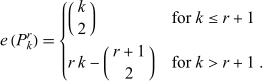
where  is the
  th
power of the path graph
th
power of the path graph  and
and
 |
(2)
|
Vasilev's extremal result also gives the Cheeger constant  for
for  .
The
.
The  -antiprism graph is the special case
  , so its Cheeger constant is
  for
for  . For
. For  ,
,  is a complete graph,
whose Cheeger constant is
is a complete graph,
whose Cheeger constant is ![[n/2]](/images/equations/CyclePowerGraph/Inline48.svg) .
.
The consecutive vertex sets need not be the only maximizers. For example, label the vertices of the underlying cycle graph  as 1, 2, ..., 6 in cyclic order. The vertices numbered 1,
3, and 5 then form a triangle in
as 1, 2, ..., 6 in cyclic order. The vertices numbered 1,
3, and 5 then form a triangle in  , so this nonconsecutive vertex set also induces the maximum
of three edges. A classification of all maximizing vertex sets remains open (Vasilev
2026).
, so this nonconsecutive vertex set also induces the maximum
of three edges. A classification of all maximizing vertex sets remains open (Vasilev
2026).
