


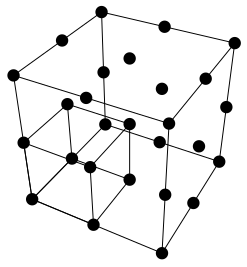
A cubic number is a figurate number of the form  with
with  a nonnegative
integer. The first few are 0, 1, 8, 27, 64, 125, 216, 343, ... (OEIS A000578).
The protagonist Christopher in the novel The
Curious Incident of the Dog in the Night-Time recites the cubic numbers to
calm himself and prevent himself from wanting to hit someone (Haddon 2003, p. 213).
a nonnegative
integer. The first few are 0, 1, 8, 27, 64, 125, 216, 343, ... (OEIS A000578).
The protagonist Christopher in the novel The
Curious Incident of the Dog in the Night-Time recites the cubic numbers to
calm himself and prevent himself from wanting to hit someone (Haddon 2003, p. 213).
The generating function giving the cubic numbers is
 |
(1)
|
The hex pyramidal numbers are equivalent to the cubic numbers (Conway and Guy 1996).

The plots above show the first 255 (top figure) and 511 (bottom figure) positive cubic numbers represented in binary.
Pollock (1843-1850) conjectured that every number is the sum of at most 9 cubic numbers (Dickson 2005, p. 23). As a part of the study of Waring's
problem, it is known that every positive integer
is a sum of no more than 9 positive cubes ( , proved by Dickson, Pillai, and Niven in the early twentieth
century), that every "sufficiently large" integer
is a sum of no more than 7 positive cubes (
, proved by Dickson, Pillai, and Niven in the early twentieth
century), that every "sufficiently large" integer
is a sum of no more than 7 positive cubes ( ). However, it is not known if 7 can be reduced (Wells
1986, p. 70). The number of positive cubes needed to represent the numbers
1, 2, 3, ... are 1, 2, 3, 4, 5, 6, 7, 1, 2, 3, 4, 5, 6, 7, 8, 2, ...(OEIS A002376),
and the number of distinct ways to represent the numbers 1, 2, 3, ... in terms of
positive cubes are 1, 1, 1, 1, 1, 1, 1, 2, 2, 2, 2, 2, 2, 2, 2, 3, 3, 3, 3, 3, 3,
3, 3, 4, 4, 4, 5, 5, 5, 5, ... (OEIS A003108).
). However, it is not known if 7 can be reduced (Wells
1986, p. 70). The number of positive cubes needed to represent the numbers
1, 2, 3, ... are 1, 2, 3, 4, 5, 6, 7, 1, 2, 3, 4, 5, 6, 7, 8, 2, ...(OEIS A002376),
and the number of distinct ways to represent the numbers 1, 2, 3, ... in terms of
positive cubes are 1, 1, 1, 1, 1, 1, 1, 2, 2, 2, 2, 2, 2, 2, 2, 3, 3, 3, 3, 3, 3,
3, 3, 4, 4, 4, 5, 5, 5, 5, ... (OEIS A003108).
In 1939, Dickson proved that the only integers requiring nine positive cubes are 23 and 239. Wieferich proved that only 15 integers
require eight cubes: 15, 22, 50, 114, 167, 175, 186, 212, 231, 238, 303, 364, 420,
428, and 454 (OEIS A018889). The quantity  in Waring's
problem therefore satisfies
in Waring's
problem therefore satisfies  , and the largest number known requiring seven cubes
is 8042. Deshouillers et al. (2000) conjectured that 7373170279850 is the
largest integer that cannot be expressed as the sum of
four nonnegative cubes.
, and the largest number known requiring seven cubes
is 8042. Deshouillers et al. (2000) conjectured that 7373170279850 is the
largest integer that cannot be expressed as the sum of
four nonnegative cubes.
The following table gives the first few numbers whose minimum number of positive cubes in a sum representing them is  , 2, 3, ..., 9. Thus, each number in row
  is a sum of
  positive cubes but cannot be expressed using fewer.
 | OEIS | numbers |
| 1 | A000578 | 1, 8, 27, 64, 125, 216, 343, 512, ... |
| 2 | A003325 | 2, 9, 16, 28, 35, 54, 65, 72, 91, ... |
| 3 | A047702 | 3, 10, 17, 24, 29, 36, 43, 55, 62, ... |
| 4 | A047703 | 4, 11, 18, 25, 30, 32, 37, 44, 51, ... |
| 5 | A047704 | 5, 12, 19, 26, 31, 33, 38, 40, 45, ... |
| 6 | A046040 | 6, 13, 20, 34, 39, 41, 46, 48, 53, ... |
| 7 | A018890 | 7, 14, 21, 42, 47, 49, 61, 77, ... |
| 8 | A018889 | 15, 22, 50, 114, 167, 175, 186, ... |
| 9 | A018888 | 23, 239 |
There is a finite set of numbers which cannot be expressed as the sum of distinct positive cubes: 2, 3, 4, 5, 6, 7, 10, 11, 12, 13, 14, 15, 16, 17, 18, 19, 20, 21, 22, 23, 24, 25, 26, ...(OEIS A001476).
It is known that every integer is a sum of at most 5 signed cubes ( in Waring's problem). It is believed that
5 can be reduced to 4, so that
in Waring's problem). It is believed that
5 can be reduced to 4, so that
 |
(2)
|
for any number  ,
although this has not been proved for numbers of the form
,
although this has not been proved for numbers of the form  . However, every multiple of 6 can
be represented as a sum of four signed cubes as
a result of the algebraic identity
. However, every multiple of 6 can
be represented as a sum of four signed cubes as
a result of the algebraic identity
 |
(3)
|
In the case of three signed cubes, one seeks integer solutions of
 |
(4)
|
Booker (2019) found representations for 33 and 795, and Booker and Sutherland (2021) found representations for 42, 165, 579, and 906 and a new representation for 3. Thus
every positive  not of the form
  was known to be a sum of three
signed cubes by 2021, with the exceptions 114, 390, 627, 633, 732, 921, and 975,
for which no representations were then known (Booker and Sutherland 2021). Examples
from these and earlier searches (Miller and Woollett 1955; Gardiner et al. 1964;
Guy 1994, p. 151; Elsenhans and Jahnel 2007; Huisman 2016; Mishima) include:
was known to be a sum of three
signed cubes by 2021, with the exceptions 114, 390, 627, 633, 732, 921, and 975,
for which no representations were then known (Booker and Sutherland 2021). Examples
from these and earlier searches (Miller and Woollett 1955; Gardiner et al. 1964;
Guy 1994, p. 151; Elsenhans and Jahnel 2007; Huisman 2016; Mishima) include:
 |  |  |
(5)
|
 |  |  |
(6)
|
 |  |  |
(7)
|
 |  |  |
(8)
|
 |  |  |
(9)
|
 |  |  |
(10)
|
 |  |  |
(11)
|
 |  |  |
(12)
|
 |  |  |
(13)
|
 |  |  |
(14)
|
 |  |  |
(15)
|
 |  |  |
(16)
|
 |  |  |
(17)
|
 |  |  |
(18)
|
 |  |  |
(19)
|
 |  |  |
(20)
|
 |  |  |
(21)
|
 |  |  |
(22)
|
 |  |  |
(23)
|
Equation (4) has no integer solutions for  of the form
  , since a cube is congruent
to 0, 1, or
, since a cube is congruent
to 0, 1, or  modulo 9, and three such residues cannot sum to 4 or
5 modulo 9 (Hardy and Wright 1979, p. 327). The seven exceptions listed above
do not have this obstruction. Mahler proved that 1 has infinitely many representations
as three signed cubes.
modulo 9, and three such residues cannot sum to 4 or
5 modulo 9 (Hardy and Wright 1979, p. 327). The seven exceptions listed above
do not have this obstruction. Mahler proved that 1 has infinitely many representations
as three signed cubes.
If one also excludes numbers of the form  , every number can be represented
as a sum of four signed cubes, using one of the following algebraic identities,
or their complementary identities (via
, every number can be represented
as a sum of four signed cubes, using one of the following algebraic identities,
or their complementary identities (via  ):
):
 |  |  |
(24)
|
 |  |  |
(25)
|
 |  |  |
(26)
|
 |  |  |
(27)
|
 |  |  |
(28)
|
 |  |  |
(29)
|
 |  |  |
(30)
|
 |  |  |
(31)
|
 |  |  |
(32)
|
These identities,and a proof for  were given by Demjanenko (Demjanenko 1966, Cohen 2004).
The following table gives the numbers which can be represented in exactly  different ways as a sum of
  positive cubes, with permutations
of the summands counted only once. Taking the union over all
positive cubes, with permutations
of the summands counted only once. Taking the union over all  for a given
  gives the numbers representable as sums of exactly
  positive cubes. This can include numbers whose minimum number
of cubes is smaller than
positive cubes. This can include numbers whose minimum number
of cubes is smaller than  ,
such as
,
such as  .
To obtain row
.
To obtain row  of the previous table, also exclude numbers representable using fewer than
  positive cubes. For example,
 |
(33)
|
can be represented in  ways by
  cubes. The smallest number representable in
  ways as a sum of
  cubes,
 |
(34)
|
is called the Hardy-Ramanujan number and has special significance in the history of mathematics as a result of a story told
by Hardy about Ramanujan. Note that OEIS A001235
is defined as the sequence of numbers which are the sum of cubes in two or more
ways, and so appears identical in the first few terms to the  series given below.
 |  | OEIS | numbers |
| 1 | 0 | A007412 | 2, 3, 4, 5, 6, 7, 9, 10, 11, 12, 13, 14, ... |
| 1 | 1 | A000578 | 1, 8, 27, 64, 125, 216, 343, 512, ... |
| 2 | 0 | A057903 | 1, 3, 4, 5, 6, 7, 8, 10, 11, 12, 13, 14, ... |
| 2 | 1 | 2, 9, 16, 28, 35, 54, 65, 72, 91, ... | |
| 2 | 2 | 1729, 4104, 13832, 20683, 32832, ... | |
| 2 | 3 | A003825 | 87539319, 119824488, 143604279, ... |
| 2 | 4 | A003826 | 6963472309248, 12625136269928, ... |
| 2 | 5 | 48988659276962496, ... | |
| 2 | 6 | 8230545258248091551205888, ... | |
| 3 | 0 | A057904 | 1, 2, 4, 5, 6, 7, 8, 9, 11, 12, 13, 14, ... |
| 3 | 1 | A025395 | 3, 10, 17, 24, 29, 36, 43, 55, 62, ... |
| 3 | 2 | 251, ... | |
| 4 | 0 | A057905 | 1, 2, 3, 5, 6, 7, 8, 9, 10, 12, 13, 14, ... |
| 4 | 1 | A025403 | 4, 11, 18, 25, 30, 32, 37, 44, 51, ... |
| 4 | 2 | A025404 | 219, 252, 259, 278, 315, 376, 467, ... |
| 5 | 0 | A057906 | 1, 2, 3, 4, 6, 7, 8, 9, 10, 11, 13, 14, 15, ... |
| 5 | 1 | A048926 | 5, 12, 19, 26, 31, 33, 38, 40, 45, ... |
| 5 | 2 | A048927 | 157, 220, 227, 246, 253, 260, 267, ... |
| 6 | 0 | A057907 | 1, 2, 3, 4, 5, 7, 8, 9, 10, 11, 12, 14, 15, ... |
| 6 | 1 | A048929 | 6, 13, 20, 27, 32, 34, 39, 41, 46, ... |
| 6 | 2 | A048930 | 158, 165, 184, 228, 235, 247, 256, ... |
| 6 | 3 | A048931 | 221, 254, 369, 411, 443, 469, 495, ... |
The following table gives the possible residues (mod  ) for cubic numbers for
  to 20, as well as the number of distinct residues
  .
.
 |  |  |
| 2 | 2 | 0, 1 |
| 3 | 3 | 0, 1, 2 |
| 4 | 3 | 0, 1, 3 |
| 5 | 5 | 0, 1, 2, 3, 4 |
| 6 | 6 | 0, 1, 2, 3, 4, 5 |
| 7 | 3 | 0, 1, 6 |
| 8 | 5 | 0, 1, 3, 5, 7 |
| 9 | 3 | 0, 1, 8 |
| 10 | 10 | 0, 1, 2, 3, 4, 5, 6, 7, 8, 9 |
| 11 | 11 | 0, 1, 2, 3, 4, 5, 6, 7, 8, 9, 10 |
| 12 | 9 | 0, 1, 3, 4, 5, 7, 8, 9, 11 |
| 13 | 5 | 0, 1, 5, 8, 12 |
| 14 | 6 | 0, 1, 6, 7, 8, 13 |
| 15 | 15 | 0, 1, 2, 3, 4, 5, 6, 7, 8, 9, 10, 11, 12, 13, 14 |
| 16 | 10 | 0, 1, 3, 5, 7, 8, 9, 11, 13, 15 |
| 17 | 17 | 0, 1, 2, 3, 4, 5, 6, 7, 8, 9, 10, 11, 12, 13, 14, 15, 16 |
| 18 | 6 | 0, 1, 8, 9, 10, 17 |
| 19 | 7 | 0, 1, 7, 8, 11, 12, 18 |
| 20 | 15 | 0, 1, 3, 4, 5, 7, 8, 9, 11, 12, 13, 15, 16, 17, 19 |
Dudeney found two rational numbers other than 1 and 2 whose cubes sum to nine,
 |
(35)
|
(Gardner 1958). The problem of finding two rational numbers whose cubes sum to six was "proved" impossible by Legendre. However, Dudeney found the simple solutions 17/21 and 37/21.
The only three consecutive integers whose cubes sum to a cube are given by the Diophantine equation
 |
(36)
|
Catalan's conjecture, proved by Mihăilescu (2004), states that 8 and 9 ( and
and  ) are the only consecutive perfect
powers greater than 1, i.e., the only solution to Catalan's
Diophantine problem. In particular, 8 and 9 are the only consecutive cubic and
square numbers (in either order).
) are the only consecutive perfect
powers greater than 1, i.e., the only solution to Catalan's
Diophantine problem. In particular, 8 and 9 are the only consecutive cubic and
square numbers (in either order).
There are six positive integers equal to the sum of the digits of their cubes: 1, 8, 17, 18, 26, and 27 (OEIS A046459; Moret Blanc 1879). There are four positive integers equal to the sums of the cubes of their digits:
 |  |  |
(37)
|
 |  |  |
(38)
|
 |  |  |
(39)
|
 |  |  |
(40)
|
(Ball and Coxeter 1987). There are two square numbers of the form  :
:  and
and  (Le Lionnais 1983). A cube cannot be the concatenation
of two cubes, since if
(Le Lionnais 1983). A cube cannot be the concatenation
of two cubes, since if  is the concatenation of
  and
and  ,
then
,
then  ,
where
,
where  is the number of digits in
  . After shifting any powers of 1000 in
  into
into  , the original problem is equivalent to finding a solution
to one of the Diophantine equations
, the original problem is equivalent to finding a solution
to one of the Diophantine equations
 |  |  |
(41)
|
 |  |  |
(42)
|
 |  |  |
(43)
|
None of these have solutions in integers, as proved independently by Sylvester, Lucas, and Pepin (Dickson 2005, pp. 572-578).

 via Lattice Reduction." In
  for
for  Neither a Cube nor Twice a Cube." Apr. 19,
2007.
Neither a Cube nor Twice a Cube." Apr. 19,
2007.  ." Math. Comput. 18, 408-413,
1964.Gardner, M. "Mathematical Games: About Henry Ernest Dudeney,
A Brilliant Creator of Puzzles." Sci. Amer. 198, 108-112, Jun.
1958.Guy, R. K. "Sum of Four Cubes." §D5 in
." Math. Comput. 18, 408-413,
1964.Gardner, M. "Mathematical Games: About Henry Ernest Dudeney,
A Brilliant Creator of Puzzles." Sci. Amer. 198, 108-112, Jun.
1958.Guy, R. K. "Sum of Four Cubes." §D5 in  on a Vector Computer." Math. Comput. 61,
235-244, 1993.Huisman, S. G. "Newer Sums of Three Cubes."
26 Apr 2016.
on a Vector Computer." Math. Comput. 61,
235-244, 1993.Huisman, S. G. "Newer Sums of Three Cubes."
26 Apr 2016.  ."
J. London Math. Soc. 30, 101-110, 1955.Mishima, H. "
."
J. London Math. Soc. 30, 101-110, 1955.Mishima, H. " ."
."