

Correlation analysis is the statistical study of the direction and strength of association among variables. For two nonconstant paired data series, linear association is commonly summarized by the correlation coefficient
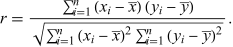 |
Here,  and
and  are the sample means. Values near
  or
or  indicate strong positive or negative linear association,
while a value near 0 indicates little linear association. A small correlation does
not rule out a nonlinear relationship, and correlation alone does not establish causation.
Ranked data can be summarized by the Spearman
rank correlation coefficient, while dependence between values of a time series
at different lags is measured by autocorrelation.
indicate strong positive or negative linear association,
while a value near 0 indicates little linear association. A small correlation does
not rule out a nonlinear relationship, and correlation alone does not establish causation.
Ranked data can be summarized by the Spearman
rank correlation coefficient, while dependence between values of a time series
at different lags is measured by autocorrelation.
