

The Spearman rank correlation coefficient, often shortened to Spearman rank correlation and also called Spearman's rho, is a nonparametric (distribution-free) rank statistic
proposed by Spearman in 1904 as a measure of the strength of the monotone association
between two variables (Lehmann and D'Abrera 1998). The coefficient is commonly denoted
 ,
while
,
while  is also used for its sample value. It can be used to give
an R-estimate and is useful when the distribution
of the data makes Pearson's correlation coefficient
undesirable or misleading.
is also used for its sample value. It can be used to give
an R-estimate and is useful when the distribution
of the data makes Pearson's correlation coefficient
undesirable or misleading.
For a sample of  pairs, let
  and
and  be the statistical ranks
of the two components of pair
be the statistical ranks
of the two components of pair  , with respective means
 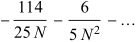 and
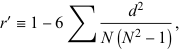
and  . The sample Spearman rank correlation coefficient is the
Pearson correlation coefficient of these
ranks,
. The sample Spearman rank correlation coefficient is the
Pearson correlation coefficient of these
ranks,
 |
(1)
|
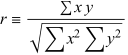
If there are no tied statistical ranks and  ,
this simplifies exactly to
,
this simplifies exactly to
 |
(2)
|
When ties occur, the Pearson correlation coefficient of the statistical ranks remains the definition, while the shortcut formula must be replaced by a tie-corrected form.
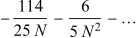
Under the null hypothesis that the two rank orderings are independent, with no ties,  has mean 0. Its variance, kurtosis excess, and odd standardized
moments include
has mean 0. Its variance, kurtosis excess, and odd standardized
moments include
 |  |  |
(3)
|
 |  |  |
(4)
|
 |  |  |
(5)
|
Student was the first to obtain the variance.
