

The correlation coefficient, sometimes also called the cross-correlation coefficient, Pearson correlation coefficient (PCC), Pearson's  , the Perason product-moment correlation coefficient (PPMCC),
or the bivariate correlation, is a quantity that gives the quality of a least
squares fitting to the original data. To define the correlation coefficient,
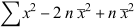
first consider the sum of squared values
, the Perason product-moment correlation coefficient (PPMCC),
or the bivariate correlation, is a quantity that gives the quality of a least
squares fitting to the original data. To define the correlation coefficient,
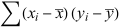
first consider the sum of squared values  ,
,  , and
, and  of a set of
  data points
  about their respective means,
 |  |  |
(1)
|
 |  |  |
(2)
|
 |  |  |
(3)
|
 |  |  |
(4)
|
 |  |  |
(5)
|
 |  |  |
(6)
|
 |  |  |
(7)
|
 |  |  |
(8)
|
 |  |  |
(9)
|
 |  |  |
(10)
|
 |  |  |
(11)
|
 |  |  |
(12)
|
These quantities are simply unnormalized forms of the variances and covariance of  and
and  given by
 |  |  |
(13)
|
 |  |  |
(14)
|
 |  |  |
(15)
|
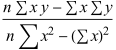
For linear least squares fitting, the coefficient  in
in
 |
(16)
|
is given by
 |  |  |
(17)
|
 |  |  |
(18)
|
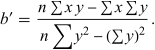
and the coefficient  in
in
 |
(19)
|
is given by
 |
(20)
|
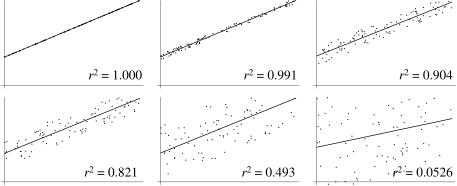
The correlation coefficient  (sometimes also denoted
  ) is then defined by
 |  |  |
(21)
|
 |  |  |
(22)
|
The correlation coefficient is also known as the product-moment coefficient of correlation or Pearson's correlation. The correlation coefficients for linear fits to increasingly noisy data are shown above.
The correlation coefficient has an important physical interpretation. To see this, define
![A=[sumx^2-nx^_^2]^(-1)](/images/equations/CorrelationCoefficient/NumberedEquation4.svg) |
(23)
|
and denote the "expected" value for  as
as  . Sums of
  are then
 |  |  |
(24)
|
 |  |  |
(25)
|
 |  |  |
(26)
|
 |  |  |
(27)
|
 |  | ![A[y^_sumx^2+(x_i-x^_)sumxy-nx^_y^_x_i]](/images/equations/CorrelationCoefficient/Inline87.svg) |
(28)
|
 |  |  |
(29)
|
 |  | ![A^2[ny^_^2(sumx^2)^2-n^2x^_^2y^_^2(sumx^2)-2nx^_y^_(sumxy)(sumx^2)+2n^2x^_^3y^_(sumxy)+(sumx^2)(sumxy)^2-nx^_^2(sumxy)]](/images/equations/CorrelationCoefficient/Inline93.svg) |
(30)
|
 |  | ![Asum[y_iy^_sumx^2+y_i(x_i-x^_)sumxy-nx^_y^_x_iy_i]](/images/equations/CorrelationCoefficient/Inline96.svg) |
(31)
|
 |  | ![A[ny^_^2sumx^2+(sumxy)^2-nx^_y^_sumxy-nx^_y^_(sumxy)]](/images/equations/CorrelationCoefficient/Inline99.svg) |
(32)
|
 |  | ![A[ny^_^2sumx^2+(sumxy)^2-2nx^_y^_sumxy].](/images/equations/CorrelationCoefficient/Inline102.svg) |
(33)
|
The sum of squared errors is then
 |  |  |
(34)
|
 |  |  |
(35)
|
 |  |  |
(36)
|
 |  | 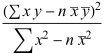 |
(37)
|
 |  |  |
(38)
|
 |  |  |
(39)
|
 |  |  |
(40)
|
 |  |  |
(41)
|
and the sum of squared residuals is
 |  |  |
(42)
|
 |  |  |
(43)
|
 |  | ![sum[y_i-y^_-b(x_i-x^_)]^2](/images/equations/CorrelationCoefficient/Inline135.svg) |
(44)
|
 |  |  |
(45)
|
 |  |  |
(46)
|
But
 |  |  |
(47)
|
 |  |  |
(48)
|
so
 |  | 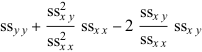 |
(49)
|
 |  |  |
(50)
|
 |  | 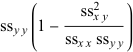 |
(51)
|
 |  |  |
(52)
|
and
 |
(53)
|
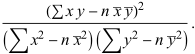
The square of the correlation coefficient  is therefore given by
 |  |  |
(54)
|
 |  |  |
(55)
|
 |  |  |
(56)
|
In other words,  is the proportion of
  which is accounted for by the regression.
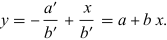
If there is complete correlation, then the lines obtained by solving for best-fit  and
and  coincide (since all data points lie on them), so solving (◇) for
  and equating to (◇) gives
 |
(57)
|
Therefore,  and
and  ,
giving
,
giving
 |
(58)
|
The correlation coefficient is independent of both origin and scale, so
 |
(59)
|
where
 |  |  |
(60)
|
 |  |  |
(61)
|

 " and "Properties of
  ." §10.1-10.2 in