

A coordination game is a game in which the players can obtain mutual gains by choosing compatible strategies. In a two-player coordination game with two strategies per player, the payoffs can be written
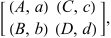 |
where  ,
 ,
 , and
 . The two diagonal outcomes are then pure-strategy Nash equilibria.
When the players rank the two Nash equilibria differently, the result is the battle of the sexes. When both rank one Nash equilibrium higher but strategic uncertainty can trap them at the other, the game exhibits a coordination failure.
A simple example models two drivers approaching one another. Each chooses the left or right side of the road relative to the driver's own direction of travel. Choosing
the same convention avoids a collision, whereas choosing different conventions causes
one (Ross 2023). Assigning a payoff of 1 to safe passage
and  to a collision gives the payoff matrix
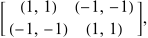 |
with rows and columns ordered left, right. The two pure-strategy Nash equilibria are (left, left) and (right, right). This is distinct from the chicken game, whose strategies are to swerve or continue straight rather than to choose a common side of the road.
