

The phrase "convergence in mean" is used in several branches of mathematics to refer to a number of different types of sequential convergence.
In functional analysis, "convergence in mean" is most often used as another name for strong
convergence. In particular, a sequence 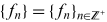 in a normed linear space
  converges in mean to an element
  whenever
 |
as  ,
where
,
where  denotes the norm on
  . Sometimes, however, a sequence
  of functions in
  is said to converge in mean if
  converges in
  -norm to a function
  for some measure space
 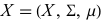 .
.
The term is also used in probability and related theories to mean something somewhat different. In these contexts, a sequence  of random
variables is said to converge in the
of random
variables is said to converge in the  th mean (or in the
  norm) to a random variable
  if the
  th absolute moments
 ![E[|X_n|^r]](/images/equations/ConvergenceinMean/Inline18.svg) and
and ![E[|X|]](/images/equations/ConvergenceinMean/Inline19.svg) all exist and if
all exist and if
![lim_(n->infty)E[|X_n-X|^r]=0,](/images/equations/ConvergenceinMean/NumberedEquation2.svg) |
where ![E[Y]](/images/equations/ConvergenceinMean/Inline20.svg) denotes the expectation value of
denotes the expectation value of  . In this usage, convergence in the
  norm for the special case
  is called "convergence in mean."
